
UFC Method of Victory Betting UK: Submission and KO Odds
 Available in US
Table of Contents
Pricing UFC Method of Victory and Submission Props
Method of victory is the market that taught me to actually study fights instead of just watching them. The first time I lost a £200 bet because I had the right winner via the wrong method, I went home and started building a database. That was eight years ago, and the database has only gotten longer because the method market keeps demonstrating, week after week, that style and division matter more than reputation.
This piece is about UFC method of victory betting from a UK bettor’s perspective: how the three pathways are priced, what divisional skews matter, and where the edge actually lives. I am not going to tell you to back the favourite by KO every time someone is a striker. The market is too sharp for that to work consistently. What I will do is walk through how to read the relationship between moneyline and method, where the cross-market value tends to surface, and what traps make this market punishing for casual bettors. Method bets are where you graduate from “I picked the winner” to “I priced the fight” — and the operator’s margin is wider here, which means the rewards and penalties are both larger.
Three pathways, one fight
Every UFC fight ends in one of three ways: KO/TKO, submission, or decision. The data is consistent across divisions and years. Roughly 53% of all UFC bouts finish inside the distance — 33.3% by KO/TKO, 19.7% by submission — with the remaining 47% going to the judges. Those base rates are the starting point for every method analysis.
The market splits into six lines on a typical UFC fight: Fighter A by KO/TKO, Fighter A by submission, Fighter A by decision, Fighter B by KO/TKO, Fighter B by submission, Fighter B by decision. Some operators add “fight ends inside the distance” and “fight goes the distance” as compact two-way markets that aggregate the six lines into broader buckets. Both versions are pricing the same underlying probabilities; the choice between them is about what shape of bet matches your read of the fight.
The six-line market typically carries an overround of 12 to 18% — meaningfully wider than moneyline’s 3 to 5%. That is the operator’s tax for the additional uncertainty in pricing six outcomes instead of two. The implication: you need a sharper edge to overcome the margin on method bets, and you need to be more selective about when you actually click.
How a method price actually shapes
Take a UFC main event where Fighter A is the 4/6 moneyline favourite. The method board might show Fighter A by KO/TKO at 7/4, Fighter A by submission at 9/2, Fighter A by decision at 5/2, Fighter B by KO/TKO at 8/1, Fighter B by submission at 10/1, Fighter B by decision at 9/2.
Read the shape. Fighter A’s KO line at 7/4 is the operator’s lead read — they think A is a finisher, and the price implies a 36% chance of A winning by KO/TKO specifically. Fighter A’s decision line at 5/2 (28.6% implied) shows the operator thinks A’s path to victory is more about finishing than winning by judges. Sum Fighter A’s three method lines and you should land near their moneyline implied probability plus the operator’s method-market overround share.
The cross-check is what makes this market interpretable. If the moneyline implies 60% for Fighter A and the method lines sum to 70% for A across all three methods, the operator has loaded their margin into the method market — common practice. If the method lines sum to 62%, the method market is sharper than the moneyline and you are seeing tight pricing. Pay attention to that gap; it tells you where the operator thinks the variance is.
Style matchup is the dominant input
Method of victory is the market where stylistic matchup matters more than name recognition. A striker against a striker tends to produce KOs. A wrestler against a striker who has a thin takedown defence tends to produce decisions or submissions. A submission grappler against a fighter with leaky ground defence tends to produce submissions. The patterns are stable across years.
What you read in the tape: takedown defence percentage, submission defence percentage, knockout-loss history, gas tank at the championship rounds, and chin durability. A fighter who has never been knocked out has a method ceiling on their KO loss line that the price should reflect. A fighter whose three losses were all submissions in round two has a method skew that becomes obvious in the price even before you study the matchup specifically.
I keep a one-line note on every UFC roster fighter that says how they win (most common method) and how they lose (most common method). When two fighters meet, the matrix of their how-they-win and how-they-lose vectors collapses the method analysis into something you can read in under a minute. If A’s most common win method is KO and B’s most common loss method is KO, the A-by-KO line is the lead bet. If A’s most common win method is decision and B’s most common loss method is KO, there is a mismatch and the method line is mispriced one way or the other — usually the way the bettor would not expect at first glance.
Divisional skews you must respect
Heavyweight finishes by KO/TKO around 50% of the time, with the decision rate at 28.6% — the lowest of any division. The implication for method bets is enormous. A heavyweight KO line at 6/4 (40% implied) is often value because the historical rate of heavyweight finishes is higher than the implied probability. A heavyweight decision line at 2/1 (33% implied) is often slightly long because the historical decision rate is 28.6%, not 33%.
Flyweight is the opposite. Decisions account for about 53% of flyweight outcomes, KOs only 24.6%, and submissions 21.7%. A flyweight decision line is often the chalk in this division, and the KO line is often longer than the underlying rate would suggest because the public assumes finishes are more frequent than they actually are.
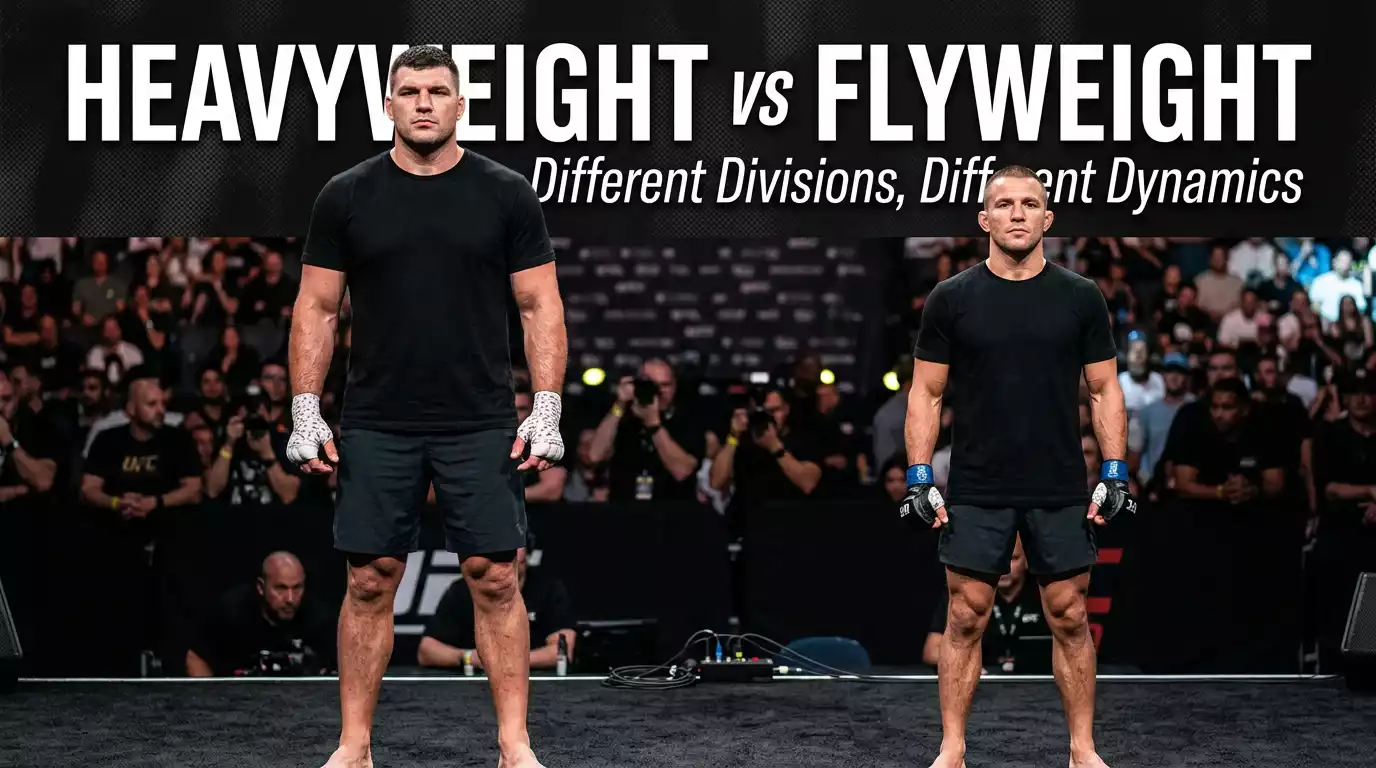
Featherweight, lightweight, welterweight and middleweight sit closer to the UFC-wide average — roughly the 33/20/47 KO/sub/decision split — with small variations. Bantamweight skews slightly more toward submissions because of the technical grappling depth in that division. Apply the divisional baseline before you apply the matchup read; the baseline alone removes a third of the noise.
Where the method-market value lives
The most consistent edge in method betting comes from combining moneyline view with method conviction. If you think Fighter A wins 60% of the time (the moneyline implies 55%) and you think they win by KO 40% of the time specifically (the method KO line implies 35%), the KO-method bet captures both edges in one bet. The expected value compounds.
The cross-market value lives in the combination, not in the individual market. A moneyline-only bet on A captures the 5-point edge. A method-only bet on A by KO captures the 5-point method edge. A bet on A by KO captures both, because the method specifies the moneyline implicitly. The catch is that you also have to be right about the method, which is harder than being right about the winner — so size your method stakes more conservatively than your moneyline stakes.
For divisional context that connects directly to method pricing, our breakdown of finish rates across UFC weight classes goes into the divisional splits with more granularity than we cover here. Use that as a reference for the divisional baseline before you read any specific matchup.
How to find value without overcommitting
The simplest method-market strategy for a UK bettor is this: bet method only when you have an explicit, structural reason for the specific outcome. A wrestler facing a thin-takedown-defence striker — A by decision is the method bet. A submission grappler facing a known sub leak — A by submission is the method bet. A heavy hitter facing a fighter with documented chin questions — A by KO is the method bet.
What you do not do is bet method on the favourite simply because you think they win. Stick with the moneyline in that scenario; method requires conviction beyond the winner. The bet builder is also worth considering when the structural read is strong: pairing moneyline with method-of-victory on the same fighter can produce builder odds that exceed the standalone method line, particularly when correlation between the two is genuine (a striker winning by KO is a positively correlated builder, and operators sometimes price it generously). UFC favourites win 65 to 70% of the time on the moneyline historically, so the cross-market discipline matters: method bets layered on top of an already-confident moneyline view tighten the variance, not loosen it.
The discipline that survives long-run variance
Method bets are higher variance than moneyline bets because you are predicting both the winner and the way they win. Twenty method bets in a season is plenty. Forty is too many for most bettors because the per-bet edge required to overcome the method overround is steep, and the discipline of saying no to fights that lack a clear method read is the entire skill. Read the matchup, read the divisional baseline, place the bet when both align, and skip the bet when they do not. The market rewards selectivity here in a way that moneyline does not — and the bettors who win at method over time are usually betting it less often than the bettors who lose.

Is method of victory better priced before or after weigh-in?
Generally tighter after weigh-in. Weigh-in confirms whether both fighters made weight and how depleted they look at the scale, which feeds directly into method probability — a drained fighter loses both KO power and submission defence simultaneously. Pre-weigh-in method prices carry an extra layer of uncertainty about physical condition, which the operator hedges by widening the overround. Post-weigh-in lines are sharper but more accurate.
Should I split stake across two methods on the same fighter?
Only when both methods are plausible structurally and the moneyline view is conviction-grade. Splitting Fighter A by KO and Fighter A by submission can hedge if the matchup suggests A finishes by one of two ways and you are not sure which, but it also stacks the operator’s overround twice — you pay margin on both legs. If the moneyline is the cleaner expression of your view, take it; the split is only worth it when the third option (decision) is genuinely off the table in your read.
Published by the bet on ufc Fight team.