UFC Prop Bets UK: Takedowns, Knockdowns and Specials
 Available in US
Table of Contents
- UFC Knockdown and Distance Prop Betting Markets UK
- Knockdown props and what they actually price
- Goes-the-distance: the cleanest prop on the board
- Takedown props and where they reward research
- Novelty UK specials worth a look
- Liquidity and availability across the card
- How props fit into a UK bettor’s weekly approach
UFC Knockdown and Distance Prop Betting Markets UK
Five years ago, prop betting on UFC fights in the UK meant maybe four or five lines per main event. Today, the larger UK operators carry forty or more props on a top headliner — knockdown markets, takedown over/unders, total significant strikes, exact-round groupings, fight bonuses, walkout time. The expansion was quiet but enormous, and most British bettors I talk to are still treating props as a sideshow rather than a market with real analytical depth. They are missing the bit where the operator’s pricing has not fully caught up with the proliferation.
This piece is about UFC prop bets in the UK: how the main prop families price, where novelty meets value, and what UK-specific specials are worth looking at. I am not pitching props as a get-rich strategy. The margins are wider than moneyline, the variance is higher, and the analytical work required per bet is greater. But for a UK bettor who has already worked out moneyline and is hungry for additional angles, props are where the most interesting reads live — particularly the props that depend on specific in-cage events rather than fight outcomes. Treat the prop market as the one most analytical bettors avoid because the work is harder, which is exactly why the value sometimes lingers there.
Knockdown props and what they actually price
Knockdown markets price events within the fight, not outcomes of the fight. “Fighter A to score a knockdown” pays if A drops B at any point — regardless of whether A goes on to win the fight. “Total knockdowns in the bout: Over 1.5” pays if the cumulative knockdowns (from either fighter) sum to two or more. These are event-driven, which makes the analytical approach different from outcome-driven markets.
The key statistic for knockdown props is the knockdown rate per fight in the relevant division. About 53% of UFC bouts end inside the distance and 33.3% specifically by KO/TKO, but knockdowns themselves (without finish) happen at roughly 60% of fights — meaning the typical UFC bout has a 60% chance of at least one knockdown being scored regardless of who wins. Operators sometimes price “any knockdown in the fight” markets at implied probabilities of 50% or lower, which is value if the divisional knockdown rate justifies a higher number.
The bettor’s job on knockdown props is to identify the fights where the divisional rate diverges most from the operator’s pricing. Heavyweight, where one-punch power dominates, often produces value on “Over 1.5 knockdowns” because two-knockdown fights are common and the prices do not always reflect that. Lightweight and welterweight have stable knockdown rates and the props tend to be sharply priced. Flyweight produces fewer knockdowns by volume despite the high pace, because the smaller fighters land less concussive shots.
Goes-the-distance: the cleanest prop on the board
“Fight to go the distance” is the prop I recommend to every UK bettor who is starting to explore the prop market. It is binary — either the fight reaches the judges’ scorecards or it does not — and the historical base rate is well-documented. Roughly 47% of UFC bouts go the distance, with the rate varying by division from about 28.6% (heavyweight) to about 53% (flyweight).
The bet aligns naturally with the Over on the rounds market but with a slightly different settlement profile: “goes the distance” requires the fight to actually finish via judges’ decision, whereas Over 2.5 settles based on time elapsed. A doctor stoppage at the end of round three is Over 2.5 on the rounds market but not “goes the distance” on the prop, because there is no judges’ decision. Read the operator’s settlement rules before you bet — most UK operators define “goes the distance” as the fight reaching the final bell and being decided on the cards, but the precise wording varies.
Value lives in the divisional skew. Flyweight “goes the distance” priced at 6/5 (45% implied) is often value because the historical rate is closer to 53%. Heavyweight “does not go the distance” priced at 4/7 (63% implied) is often value because the historical inside-the-distance rate is closer to 71%. The shape of the value depends on the operator’s read of the specific matchup, but the divisional baseline alone surfaces edges if you are patient.
Takedown props and where they reward research
Takedown markets are the most matchup-sensitive props on the board. “Total takedowns landed: Over 2.5” prices the cumulative count across both fighters. “Fighter A first to score a takedown” prices the order of takedowns. “Fighter A over 1.5 takedowns” prices a single fighter’s count.
These markets reward research because the underlying drivers — takedown attempts, takedown defence percentage, control time — are publicly available on the official stats pages for every UFC fighter. A bettor who looks up both fighters’ takedown profiles before placing a bet has a meaningful information edge on a casual bettor who is reading the market cold. Operators sometimes price “Over 1.5 takedowns” at 11/10 when both fighters’ historical rates suggest the line should be more like 4/6.
The trap on takedown props is small samples. A wrestler who averages 4 takedowns per fight on a six-fight UFC sample is not guaranteed to land takedowns against a specific opponent — the matchup matters enormously, and a strong takedown defender can shut down a high-volume wrestler entirely. Read the matchup before trusting the base rate; the prop is a structural bet, not a stats bet.
Novelty UK specials worth a look
UK operators have run an expanding line of “specials” on major UFC cards — post-fight bonus picks (Fight of the Night, Performance of the Night), walkout time, dual-finish parlays, and even the occasional weigh-in markets. These props are pure novelty in pricing terms: the operator does not have a strong model for “Fighter A to win Fight of the Night”, they are pricing it loosely based on the public’s interest in the fighter.
That looseness is where the value sometimes lives. If a fighter has won three Fight of the Night bonuses in their last five outings, the operator might still price them at 5/1 to win it again because the public does not remember the streak. Performance of the Night markets price similarly — a known finisher with a recent streak of bonuses is regularly underpriced because the historical pattern is recent enough not to be in the operator’s pricing model.

Walkout time markets (“Fighter A walks out before 9pm UK”) are pure novelty and prices are loose, but they require knowledge of card scheduling that most UK bettors do not have at their fingertips. Worth checking if you have already researched the card heavily for other reasons. As Lerone Murphy described his perfect scenario before a recent fight week: “I win this fight, I challenge Volk in maybe October or November, I win, obviously, and then I defend it in Manchester.” That kind of fighter ambition is exactly what feeds the futures-and-specials markets in UK windows — a Manchester defence story is a UK-specific narrative the operators price into walkout, post-fight bonus and Fight Night appearance markets when it comes up.
Liquidity and availability across the card
Prop markets are most liquid on the main event and on top-billed co-main fights. By the time you get to the prelim card, the available props are usually limited to goes-the-distance and basic knockdown markets — the operators do not commit research to the deeper props on prelim bouts, so they either skip them or post wider prices.
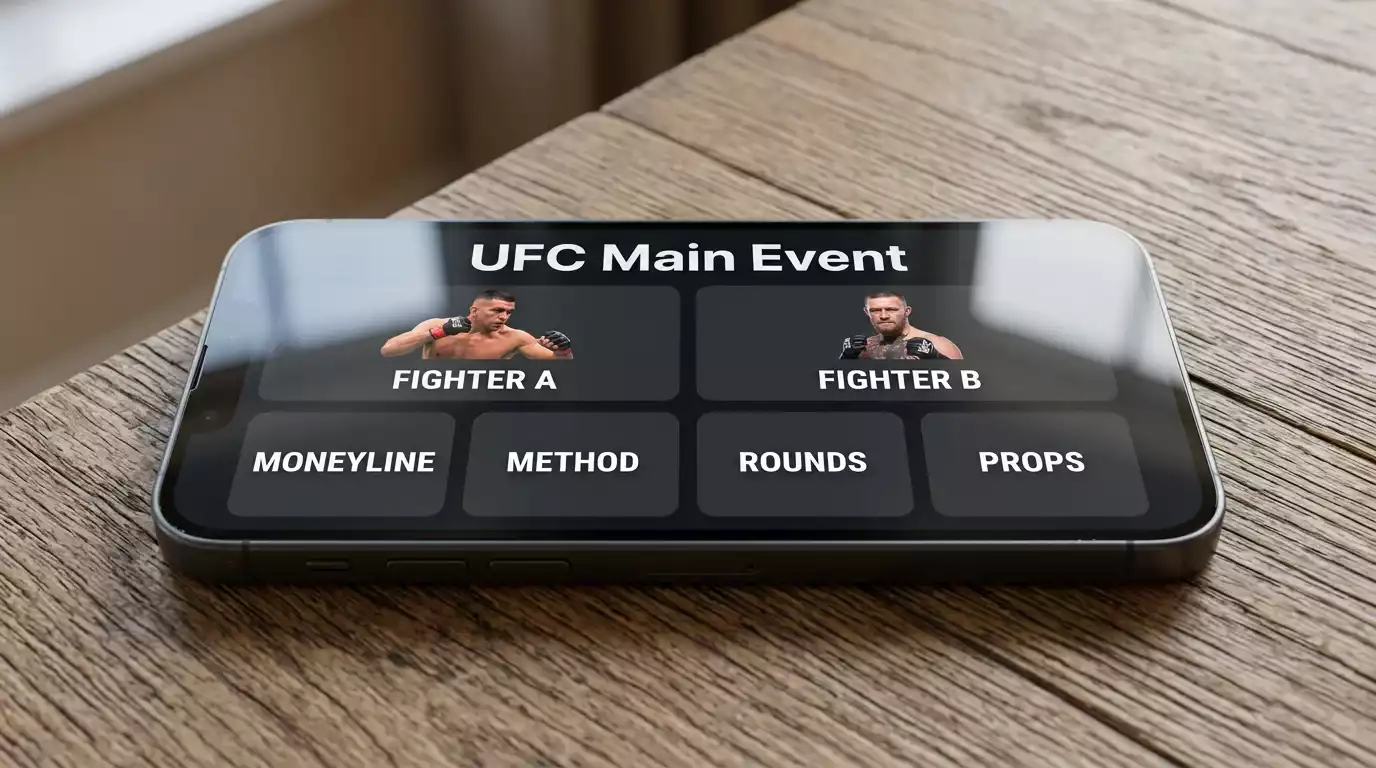
What this means for the bettor: spend your prop research time on the top three or four fights of a card and skip the prelims for props. The main event will have the deepest available market and the sharpest pricing; the co-main will have the second-deepest. Below that, the props are usually too thin to support a value-hunting approach, and you are better off sticking with moneyline or method on prelim fights. The bet builder works particularly well with main-event props because the operator’s combination pricing handles correlation across the main markets and the props in ways that can produce attractive combined odds.

How props fit into a UK bettor’s weekly approach
Props are a complementary market, not a primary one. Use them when you have a specific structural read on a fight component (knockdowns, takedowns, distance) that the operator’s pricing does not fully reflect. Skip them when your read is just “I think this fighter wins” — that is a moneyline read, and props will add margin without adding edge. The UFC main-event market in fight week is where the prop landscape is richest, and the bettors who do well at props are usually betting fewer of them, not more. Five props a card with strong structural reads beats fifteen props a card with weak ones, every season I have tracked it.
Are UFC prop bets resolved if a fight is ruled a no-contest?
Most prop bets are voided and stakes returned in the event of a no-contest, but the rule varies by operator and by prop type. Knockdown and takedown props that had already settled (the event happened before the no-contest was declared) typically stand; goes-the-distance and Fight of the Night markets are usually voided because the fight outcome itself is voided. Check each operator’s settlement rules in the prop market T&Cs — there is genuine variance between UK books on this point.
Do props count for fight-builder combinations in UK apps?
Most UK operators allow prop markets to be included in the bet builder for the same fight, but the combinations that price cleanly are limited. A moneyline plus a goes-the-distance prop combines well; a knockdown prop plus a method-of-victory bet on the same fighter often will not, because the operator views the two as too correlated and either rejects the combination or applies an aggressive correlation cut. Try the combination in the builder interface before assuming it will work.
Written by the editors at bet on ufc Fight.