UFC Cash Out Betting UK: Maximizing Live Payouts
 Available in US
Table of Contents
- UFC Partial Cash Out Strategies and Payout Values
- How the cashout price is built
- Partial cashout and what it actually does
- Auto cashout — the pre-set trigger
- When to cashout — round-end leverage points
- When not to cashout — and there are more situations than people think
- How to integrate cashout into your weekly habit
UFC Partial Cash Out Strategies and Payout Values
I cashed out my biggest UFC slip ever last summer at the start of round three of a five-round main event. My fighter was winning, I was up nearly £600 on a £100 stake, and the button glowed green at £480. I tapped it without thinking. The fight ended with my fighter winning by submission 90 seconds later. The full return would have been £600. I paid £120 of my own profit to the operator for the privilege of “locking in” — and I have never tapped that button on a winning UFC slip again.
This piece is about UFC cashout for UK bettors. I will walk through how the price is built, when partial and auto cashout actually help, and the situations where the cashout button is a value trap rather than a risk-management tool. The cashout feature is one of the most-clicked buttons on UK UFC apps, partly because it does sometimes make sense and partly because the operator has every incentive to make it feel essential. The discipline is recognising which it is in the moment.
How the cashout price is built
The cashout price is built from two components: the current implied probability of your bet still settling as a win, and the operator’s margin on the cashout offer itself. The first component is the live odds the operator currently displays for that outcome. The second is the additional margin the operator takes for offering you the early settlement.
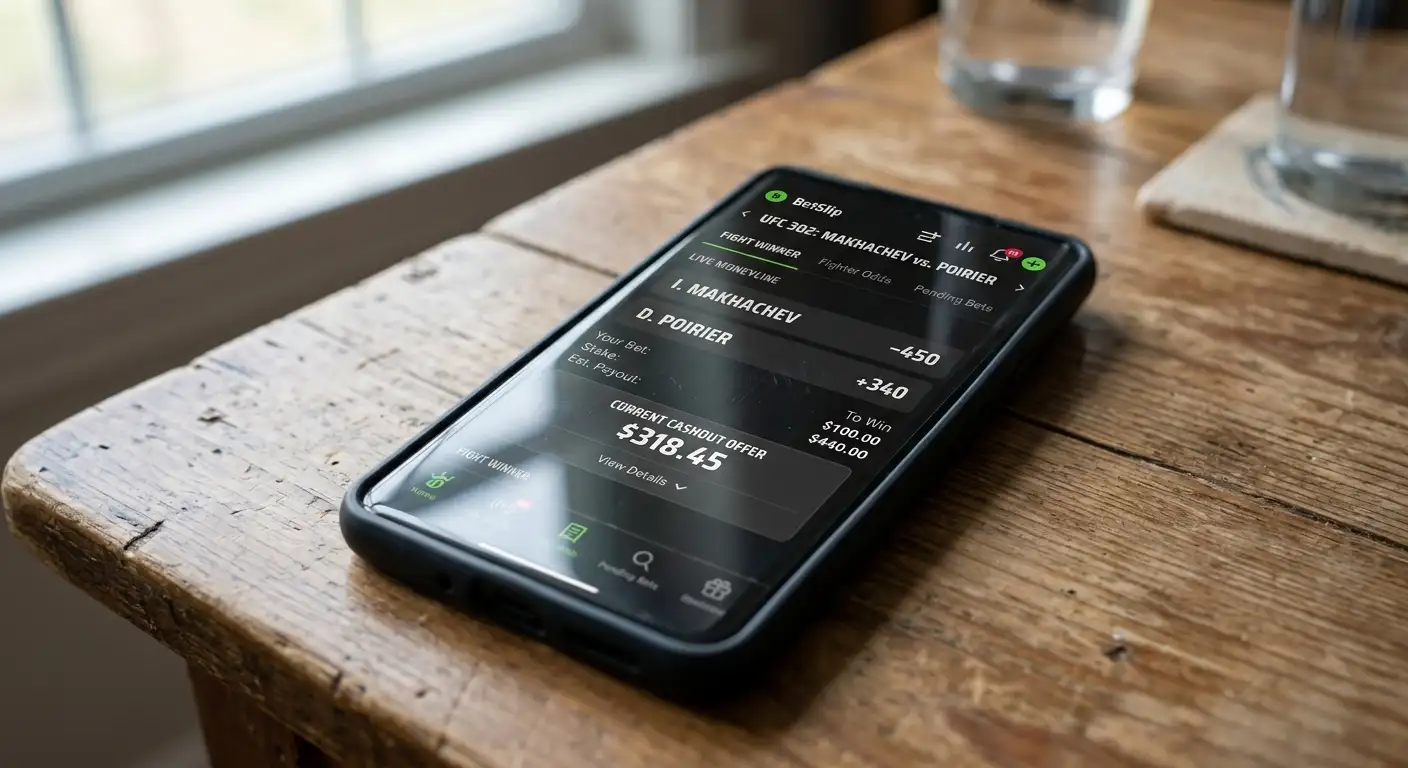
Take a UFC bet at 5/2 (decimal 3.50) on a £100 stake. The original potential return is £350. If the fight reaches the start of round three and your fighter is winning, the live odds on them might have shortened to 1/2 (decimal 1.50). The “fair” cashout for your bet would be your stake × current decimal price ÷ original decimal price, multiplied by the original stake: 100 × 1.50 ÷ 3.50 × 3.50… no, simpler: your stake of £100 at 1/2 would currently price at £150 return. So the fair cashout is £150 minus the operator’s margin.
The operator’s margin on cashout is typically 8 to 15% of the fair cashout value. A £150 fair cashout offers as £127 to £138 in practice. That margin is invisible because the operator does not show you the fair price — they just show the cashout offer. The implication: you are systematically giving up 8 to 15% of expected value every time you cash out, in exchange for certainty.
Partial cashout and what it actually does
Partial cashout lets you take a portion of the projected return now and leave the rest in play. On the same £100 stake at 5/2, a 50% partial cashout takes half the current cashout value (so £63 to £69 in cash from the earlier example) and leaves a £50 stake equivalent still live on the original 5/2 price.
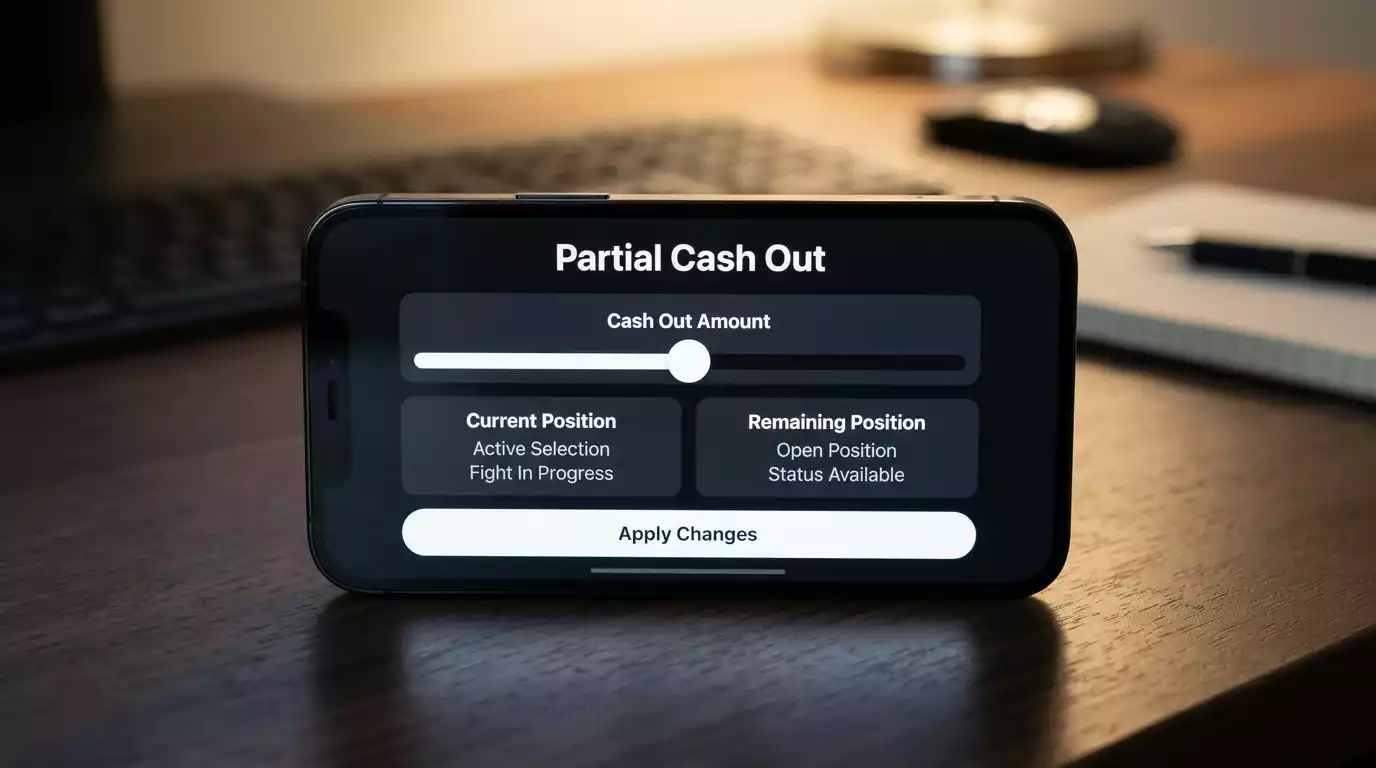
What partial cashout is good for: hedging variance on long-running bets where you want some money back but still want exposure to the upside. A long-shot bet at 10/1 that is now sitting at 5/2 with the fight to come has accumulated significant unrealised profit, and partial cashout can take that profit off the table without closing the position entirely.
What partial cashout is not good for: short-runtime bets like UFC moneylines on three-round prelims, where the fight will resolve in 15 minutes and the cashout margin compounds against you twice (once on the cashed portion and once on the still-live portion that you have effectively re-staked at a worse implied price). For most UFC single bets, full cashout is the cleaner mechanic if you are going to cashout at all.
Auto cashout — the pre-set trigger
Auto cashout lets you set a target return value before the fight starts, and the operator automatically cashes out your bet when the live cashout offer reaches that value. Set the trigger at £200 on a bet that would return £350 at full settlement, and the moment the cashout offer hits £200, the operator settles for you.
Auto cashout is a discipline tool, not an edge tool. It removes the in-fight decision from your hands and pre-commits you to a level of acceptable return. For bettors who struggle with in-play impulsivity, that pre-commitment can be useful — you do not get the chance to talk yourself out of cashing out on the night because you set the trigger when you were calm.
The catch is the same operator margin issue. Auto cashout still settles at the margin-loaded offer price, not at the fair value. Setting a £200 auto cashout on a bet whose fair value at the trigger moment is £218 means you have systematically given up £18 (about 8%) to the operator for the convenience of the auto-settle. If you would have cashed out manually at the same moment, you would have given up the same margin — auto and manual are mechanically identical, just with different decision moments.
When to cashout — round-end leverage points
The genuinely sensible times to cashout a UFC bet are narrow. They come at moments when the implied probability of your outcome has materially shifted and your read of the fight is uncertain about the next round.

The classic scenario: you backed Fighter A to win at 5/2 pre-fight. After round two, A is winning clearly and the live moneyline has shortened to 1/3 — but A’s gas tank looked unimpressive in round two and you genuinely think the third round is a coin flip on whether A or B finishes. Cashing out at the start of round three locks in a profit on the read that A was undervalued pre-fight, without exposing you to the variance of a round you no longer have confidence in. The cashout margin you pay is the price of that certainty, and on this kind of structural uncertainty, the price is worth paying.
The relevant base rate: about 53% of UFC bouts end inside the distance, with KO/TKO at 33.3%. If your fighter is up on the cards in round three but the matchup includes meaningful KO power both ways, the third-round finish probability is non-trivial. A cashout that locks in your bet against that variance is a legitimate use of the tool.
When not to cashout — and there are more situations than people think
The first scenario where cashout fails: a heavy favourite in round three of a five-round main event with no signs of cardio problems and no specific finishing threat from the opponent. The cashout offer at that moment is shorter than the fair value of the remaining rounds, and taking it just gives back margin to the operator for no real risk management benefit. Hold the bet.
The second: a moneyline bet on the dog you backed pre-fight that is currently winning. The cashout offer is enormous relative to your stake — say £400 on a £100 stake — but the live moneyline has shortened so much that the bet still has significant expected value if held. Cashing out feels rational because the absolute number is large, but it gives up the upside you correctly identified pre-fight. About 41% of UFC men’s bouts end before the 2.5 round mark, so a dog with strong fight-finishing momentum is closer to settling than the cashout offer reflects.
The third: any cashout offer where the implied price (cashout value ÷ stake) is shorter than the implied probability you would assign to the fighter winning from this point. Mathematically, if you would have bet on this fighter at this price right now, you should not be cashing out — you should be doubling down or doing nothing. Cashout makes sense when your forward-looking probability estimate has dropped meaningfully, not when it has merely become certain. Our coverage of how to read the in-play market as a UK bettor goes into the corner-reading discipline that informs forward-looking probability in detail.
How to integrate cashout into your weekly habit
For most UK UFC bettors, the right default is: do not cashout. Hold the bet, watch the fight, take the settled result whichever way it lands. Use cashout only when a specific structural read suggests the fight has become genuinely uncertain in a way you cannot easily quantify. Auto cashout can be useful for bettors who lose discipline in-play, but the margin cost is real and worth being aware of.

The honest summary: cashout is a feature that benefits the operator on most clicks and the bettor on a minority of clicks. The 8 to 15% margin per cashout is a tax on certainty. Pay it when you genuinely need certainty; refuse it when you do not. The bettors I know who use cashout sparingly outperform the bettors who use it impulsively, over any sample I have tracked. Treat the button as a tool, not a reflex, and your long-run returns improve without any change to your underlying betting discipline.
Why was cashout not offered for my UFC bet after a knockdown?
Operators temporarily suspend cashout offers when a significant in-fight event happens that would shift the implied probability sharply, until they have re-priced the live market. A knockdown is one of the events that triggers a suspension — typically 30 to 90 seconds while the operator’s traders adjust the live odds. The cashout offer reappears once the new line is set, but at a different value than it was before the knockdown. This is normal operator practice rather than a malfunction.
Does cashout affect parlay legs or just single UFC bets?
Cashout works on accumulators as well as singles, but the mechanic is different. On a multi-leg parlay, cashout settles the entire slip at the operator’s current cashout offer, which is built from the implied probabilities of all unfinished legs combining successfully. You cannot cashout individual legs of a parlay while leaving others live — it is all or partial across the whole slip. Partial cashout on parlays takes a percentage of the current projected return now and leaves the proportional remainder live on the full slip price.
Written by the editors at bet on ufc Fight.