UFC Betting Odds UK: Fractional and Decimal Formats
 Available in US
Table of Contents
- Reading UFC Betting Lines and Odds Formats UK
- Fractional Odds The Way Britain Still Writes Them
- Switching To Decimal Without Losing The Plot
- Turning Prices Into Probabilities You Can Actually Use
- How The Price Bends Around The Market You’re Betting
- What Moves A UFC Line Between Open And Walkout
- Reading A UK Bookmaker’s UFC Board Without Getting Lost
- The Cheap Mistakes That Cost UK Bettors Real Money
Reading UFC Betting Lines and Odds Formats UK
The first UFC card I priced for a UK desk, back in 2017, I made the silly mistake of explaining the favourite as “minus one-forty” to a punter on the phone. He just laughed and asked me to “talk in British, mate”. That conversation taught me more about ufc odds uk than any seminar I ever sat through — because the format the bookmaker shows you is not just a number on a screen. It is the language your bookmaker has agreed to speak with you, and in Britain that language is still fractional by default, decimal on request, and never American unless you’ve gone looking for trouble.
Nine years of building UFC pricing models for British operators has taught me something the imported US guides keep missing. A punter in Manchester does not need to learn what minus-one-forty means. He needs to be fluent in 5/2, in 11/10, in the dance between 4/5 and 4/6 that separates a fair price from a trap. UK gambling is a £16.8 billion gross gambling yield economy that grew 7.3% in the year to March, and inside that, MMA-curious bettors arrive looking for plain reading instructions written for the board they actually see.
This manual exists because most of what passes for a UFC odds guide on the British internet is either thinly disguised American copy with the dollar signs swapped, or a one-screen primer that stops at “1.5 odds means £1.50”. I’m going to take you from the basic shape of a fractional line, through decimal toggling, implied probability, the structural quirks of each UFC market, line movement on fight week, and the misreads that cost UK punters real money on a regular basis. Every example uses British stake sizes. Every calculation matches what your slip will return.
Fractional Odds The Way Britain Still Writes Them
Ask a bookmaker in Leicester why he still chalks 5/2 on his board when the rest of the world prefers 3.50, and he’ll shrug and tell you it’s how his father wrote it. Fractional odds are older than the decimal point in betting — they were already standard at British racecourses before the moneyline format crossed the Atlantic, and the Gambling Commission’s modern operators have inherited that grammar straight from the high-street shop floor.
The fraction itself is a profit-to-stake ratio. The number on the left tells you what you win. The number on the right tells you what you must stake. So 5/2 is read as “five to two” and means that for every two pounds you stake, you profit five. Stake matches that ratio in any direction. Stake £10 at 5/2 and you profit £25, returning £35 total. Stake £25 at 5/2 and you profit £62.50, returning £87.50. Stake £50 at the same line and you profit £125, returning £175. The arithmetic never changes, only the multiplier scales.
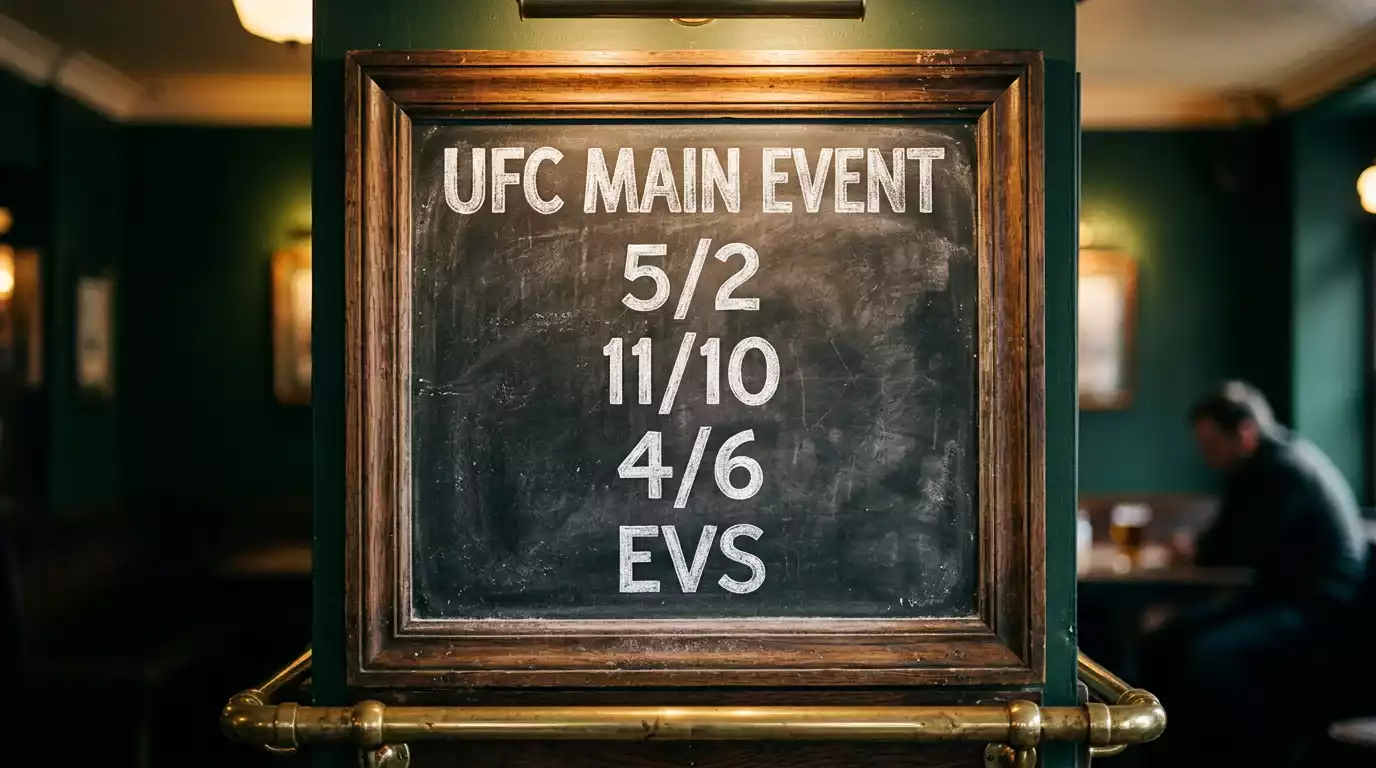
Where it gets interesting is when the favourite is heavy. A chalk priced at 4/6 reads as “four to six” — and that is below evens. You stake six to win four. So a £30 punt at 4/6 returns £20 profit and £50 total. People new to fractional often misread 4/6 as some kind of fraction of a pound; it is not. The ratio holds regardless of stake. Six units in, four units out, plus your six back.
The closer-to-pick’em prices are where the British board gets dense. A typical near-even UFC matchup will be priced 11/10 against 10/11, or 6/4 against 8/13, depending on house margin. At 11/10 a £10 stake returns £21 — that’s £11 profit on the £10 risked. At 10/11 the same £11 stake returns £21 total — exactly the mirror, with profit of £10. Bookmakers love this pricing because both sides look almost identical, and the casual eye sees them as equal value when in fact the operator has baked their margin into the fact that neither price is truly evens.
Evens itself is the line where the fraction is 1/1, written as Evs on most British boards. You stake a pound, you profit a pound. Anything tighter than that on the favourite side is called odds-on; anything wider on the dog side is odds-against. Once you learn to scan a UFC board and instantly sort the prices into odds-on, evens, and odds-against, you’ve already read three quarters of the information the operator wants you to read. The shape of the market is in those ratios.
One last thing about fractional: it is silent about implied probability. The fraction tells you what you profit, not how often the bookmaker expects you to win. That conversion is its own job and we’ll get to it after the decimal toggle.
Switching To Decimal Without Losing The Plot
Every UK-licensed operator I’ve worked with has had a toggle for decimal odds, usually buried under the account preferences or a small dropdown in the corner of the betting slip. It exists because the rest of Europe prices everything in decimal, because professional bettors crunch decimal far quicker than fractional, and because the implied probability calculation is genuinely simpler when you’ve stripped out the conversion step.
A decimal price is the total return per unit staked. That includes your stake. So 3.50 decimal means £1 returns £3.50, which is your £1 back plus £2.50 profit. Notice the relationship to fractional: 5/2 fractional is exactly 3.50 decimal. The fraction told you the profit ratio (5 win, 2 stake). The decimal tells you the multiplier on the stake (3.50 times what you put in). Same fight, same price, different grammar.
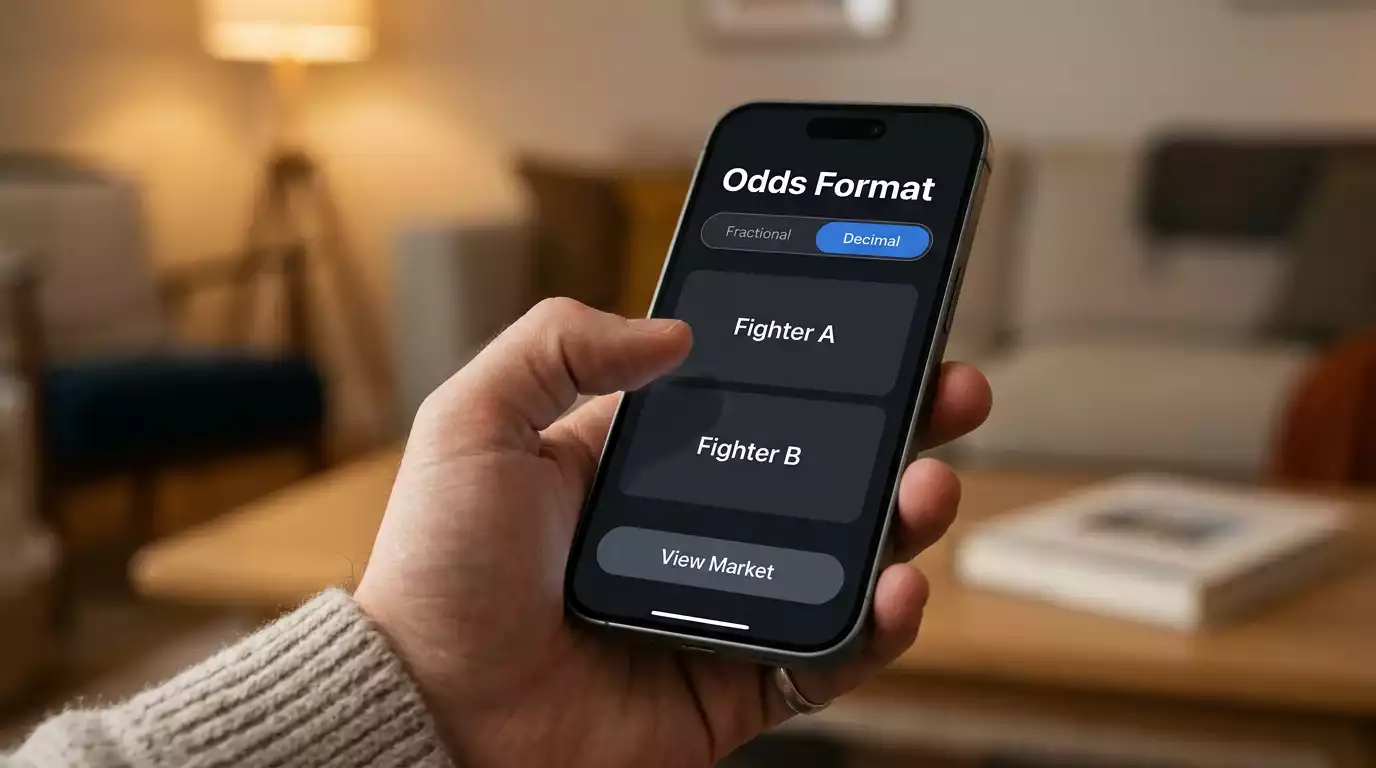
The conversion is mechanical once you’ve seen it twice. Add the numerator and denominator of the fraction, divide by the denominator, and you have the decimal. So 11/10 becomes (11+10)/10 = 21/10 = 2.10. And 4/6 becomes (4+6)/6 = 10/6 = 1.67. The reverse — decimal to fractional — is less clean because not every decimal lines up with a tidy fraction, but the British software handles that for you whenever you flick the toggle. You’ll see, for example, 1.91 displayed as 10/11 even though it should mathematically be 91/100. The operator rounds to a recognisable racecourse fraction.
Why bother with decimal at all if Britain is fractional by default? Three reasons. First, your maths gets faster. Multiplying £40 by 2.10 to see an £84 return is one step. Working out “11/10 of forty quid plus forty back” is two or three. Second, the price differences become visible at a glance. Sliding from 1.91 to 1.95 looks like a small move. Going from 10/11 to 19/20 is also a small move, but it’s harder to feel in the fraction. The decimal exposes the size of every tick. Third, when you start tracking your closing line value or comparing two operators side by side, decimal is the only sane unit. Sharp UK bettors I know all run their spreadsheets in decimal, even though they place the bet on a fractional board.
My own habit is to keep the board on fractional out of muscle memory, then mentally toggle to decimal whenever I’m doing implied probability work or comparing two operators on the same fight. The two formats are the same number — the lift is purely in switching languages quickly. That comfort is what separates a casual reader from someone who treats a UFC line as the priced statement it actually is.
Turning Prices Into Probabilities You Can Actually Use
The single most useful skill in UFC betting is converting a price into an implied probability and asking yourself whether you genuinely believe the fighter is that likely to win. Most punters skip this step. They look at a line, decide it “feels right”, and click. The discipline of the conversion is the difference between a price-taker and a price-tester.
The formula for decimal is the cleanest. Implied probability equals 1 divided by the decimal odds, expressed as a percentage. So a 3.50 favourite has an implied probability of 1/3.50 = 28.6%. The bookmaker is telling you he thinks that fighter wins roughly 29 times out of 100. A 1.50 favourite has implied probability 1/1.50 = 66.7%. A pick’em at 1.91 implies 52.4% — and notice that both sides priced at 1.91 give 52.4%, which adds to 104.8% not 100%. That extra 4.8% is the bookmaker’s overround, his guaranteed margin if the action is balanced.

The fractional version is uglier but the same thing. Divide the denominator by the sum of numerator and denominator. So 5/2 gives 2/(5+2) = 2/7 = 28.6%. The same number you’d get from the decimal 3.50. 11/10 gives 10/(11+10) = 10/21 = 47.6%. 4/6 gives 6/(4+6) = 6/10 = 60.0%. Learn three or four of these by heart and you’ll find yourself doing the maths on the train without a calculator.
The reason this matters in UFC specifically is that you can sense-check the price against the historic base rate of favourite winning. UFC favourites across a 10-year sample win between 65% and 70% of their fights. So when the board shows a fighter at 4/6 — which is 60% implied — and his profile fits the modal UFC favourite (recent win streak, no weight cut issues, no obvious style nightmare), the bookmaker is actually offering you slightly better than the base rate. That doesn’t make it a value bet by itself, but it tells you the price is not absurdly tight.
The reverse exercise is just as useful. When a fighter is priced at 1/3 — implied probability of 75% — the operator is saying this fighter will win 3 out of 4 times. That is well above the historic favourite base rate. You need a very strong reason to believe this specific fight is more lopsided than the average favourite situation. Otherwise the price is asking you to pay a premium for what the data says is no more than a normal favourite.
Overround is the other piece. On a two-sided UFC market, sum the implied probabilities of both sides. A fair market would total 100%. UK operators on UFC tend to run an overround in the 5% to 8% band — so a typical market totals 105% to 108%. If you ever see a market where the two sides add to less than 102%, either you’ve misread the board or the operator is running a promotional boosted price. Overround is the cost of doing business with the bookmaker, and learning to spot the tight markets versus the loose ones is one of the cleaner edges available to a disciplined British bettor. If you want a deeper drill on the conversion mechanics between formats, including the implied-probability shortcuts that make sense across decimal, fractional and American notation, I’ve written a separate walk-through of converting UFC odds formats that goes step by step.
How The Price Bends Around The Market You’re Betting
I once watched a punter in a Camden bookmaker drop two hundred quid on a heavyweight underdog at 7/2, then look genuinely surprised when the same fighter’s “by KO/TKO” price was 6/1. He’d assumed the method line would be roughly the same. It is never the same. Each market has its own pricing shape because the underlying probability has its own shape, and once you see that, you stop being surprised at how much money the spread on a method bet costs you compared to a straight winner.
Moneyline Pricing
The moneyline — outright winner of the fight, by any method — is the cleanest market because it has only two outcomes (we ignore the vanishingly rare draw for pricing purposes). A typical heavyweight bout might price the favourite at 4/6 and the dog at 11/10, with the overround sitting around 6%. The shape of the price is dictated by the fighter records, recent form, weight cut history, opponent style, and the linemaker’s prior on the matchup. Across the historic UFC sample, favourites land 65% to 70% of these moneylines, so a 4/6 favourite (60% implied) sits in the lower band of “fair” and is often slight value if the profile matches.
Method-of-Victory Pricing
Method markets are the same fight broken into KO/TKO, submission, and decision lanes for each fighter — six lines instead of two. The probabilities now have to sum to 100% across all six, and the overround typically widens to 12% to 18%. That widening is not a bookmaker getting greedy; it is the mathematical cost of splitting a binary into six. The dominant fact about UFC method-of-victory pricing is the underlying base rate: roughly 53% of all UFC fights end inside the distance, with 33.3% by KO/TKO and 19.7% by submission, and the remaining 47% by decision. That base rate is where the linemaker starts, then bends it for divisional and stylistic adjustments.
Round Pricing
Round betting is the third pricing shape. The over/under on rounds is essentially a method bet in disguise — fights that go the distance are over, fights that end early are under. The “under 2.5 rounds” line on a three-round bout typically prices around 11/10 to 6/4 depending on the divisional mix, and the round-by-round market (Round 1 / Round 2 / Round 3 / goes to decision) prices each round individually with the late rounds usually wider. Heavyweight specifically distorts this market because 50% of heavyweight fights end by KO/TKO and the decision rate is only 28.6%. That divisional skew should compress the “under” price on every heavyweight main event you see, and when it doesn’t, that’s a market to watch.
What Moves A UFC Line Between Open And Walkout
Fight week is when a UFC line earns or loses its money. Lines open seven to ten days before the bout, drift or sharpen during media week, lurch sideways on weigh-in day, and arrive at the walkout looking sometimes nothing like the open. Reading that motion is half of what UK fight-week analysis is actually about.

The biggest single mover is the weigh-in. In Britain, weigh-ins for UFC fight nights typically happen at midday local time on the Friday — which means the data drops into the London market before lunch, and the line will visibly re-shape across the afternoon as bookmakers absorb the news. A failed weight cut, even one missed by a fraction of a pound, will swing the moneyline two or three ticks. A visibly drained fighter on the scales has the same effect, sometimes more pronounced. I keep a watch on the official UFC weigh-in stream and have my decimal-to-fractional table open in another tab.
The second mover is sharp money. Most of the volume on a UFC card comes through casual recreational bettors, but a chunk of it — usually 10% to 20% of total handle — comes from sharper actors who have done genuine modelling. When that money goes in, the operator’s risk team responds by tightening the price on the backed side and lengthening it on the other. A line that opens at 4/6 favourite and is at 4/9 by Friday teatime has been hit by sharp money. The casual money tends to follow public sentiment around the headliner, which usually skews to the bigger name.
The third mover is news. A late camp injury report, a corner change, a hospital visit at the weigh-in, any of these can move the line several ticks in minutes. UK operators are usually quick to suspend the market while they re-price, then re-open with a new shape. If you see a UFC market suspended on a Friday afternoon, something has happened — wait for the re-open and read the new shape carefully against your prior.
The fourth, and most peculiar to UK UFC events, is the home crowd factor. The Edwards versus Brady main event at UFC London in March 2025 sold 18,583 tickets with a $4.7 million gate — the highest-grossing fight night in UFC history at the time — and the local handle into the card behaved like a Premier League derby in microcosm. UK bettors back UK fighters. Operators know this and tighten the price on home talent into fight week. That tightening is not a value tell either way, but it is a structural shift in the market that you need to read into the open price.
Pre-fight line movement should not be confused with closing line value. The closing line — the final price moments before the cage door shuts — is the market’s best estimate. Beating it consistently is the slow indicator that your reads are profitable. Anyone who tells you they’re a UFC betting expert and cannot describe their closing line value is selling you something.
Reading A UK Bookmaker’s UFC Board Without Getting Lost
Open the UFC section of any major UK book — bet365, Betway, Coral, William Hill — and the layout will be roughly the same. The card is split into bouts. Each bout has a headline moneyline, then a drop-down or “more markets” link that opens twenty to seventy additional lines depending on the operator and the prominence of the card. The icons next to each market are not decoration. They mean specific things.
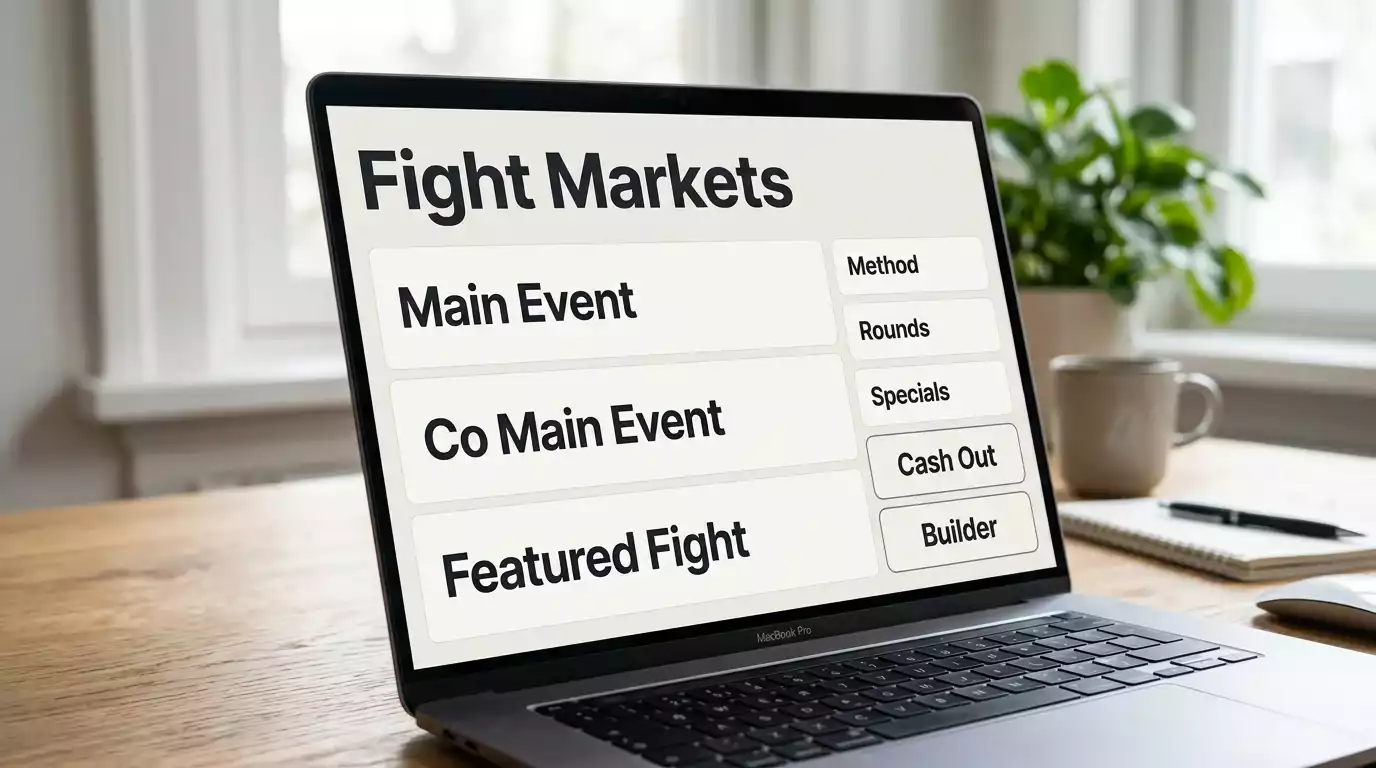
The “Cash Out” badge, usually a small dollar-style icon or a circular arrow, means the operator will let you exit the bet mid-fight at a price they calculate live. The “Bet Boost” badge means a temporarily enhanced price, often time-limited and capped at a maximum stake — useful, but read the cap. The “Builder” or “Bet Builder” badge means the bout supports the bet builder market where you combine selections within a single fight into a custom multi-leg slip. Not every operator offers builder on every bout, and the early-prelim fights on a Fight Night card are often builder-excluded.
The most underrated icon is the small “i” or “info” symbol next to a market line. Tapping it reveals the rules: what happens on a no-contest, what counts as a knockout versus a TKO, when does a round count as completed for round betting, whether a fight changed length (three to five rounds) voids the round market. These rules are not boilerplate. They differ subtly between operators and they matter when a fight finishes weirdly.
When bet365 was named the official sports betting partner of UFC in the US and Canada in March 2026, Nicholas Smith — TKO Group’s senior vice president of global partnerships — said the operator brings scale, credibility, and innovation to the sports betting space. That partnership tells you something about where UFC market depth is heading at the largest UK book: more in-broadcast integration, more market types on undercards, and a slicker board on big events. The structural lesson for the UK bettor is to expect more granularity in the markets each year, not less. To fully grasp the implied probability, you should learn about converting UFC odds across fractional and decimal formats before placing your wager.
The Cheap Mistakes That Cost UK Bettors Real Money
I keep a small notebook of the recurring misreads I’ve watched punters make on UFC boards. None of them are sophisticated errors. All of them cost money. Here are the five I see most often.

First: confusing 5/2 with 2/5. They look almost the same on the screen, separated by one slash. 5/2 is a 28.6% chance, a meaningful underdog priced to pay 3.5 times your stake. 2/5 is a 71.4% chance, a heavy favourite priced to pay 1.4 times your stake. I have watched a punter back what he thought was an underdog and end up with a chalk return. Always read the ratio in your head as a sentence: “five to two” or “two to five”. The direction matters.
Second: misreading decimal 1.91 as “almost evens”. 1.91 is not 1/1. It is 10/11. It is below evens. Both sides of a market at 1.91 sum to 104.8%, meaning the operator is taking a 4.8% margin out of the action. A genuine evens market would price both sides at 2.00 and total 100%. Whenever you see 1.91 / 1.91, the bookmaker has built his entire margin into the symmetry of the line.
Third: treating method-of-victory as a small upgrade to moneyline. The math says otherwise. A favourite who is 4/6 to win outright might be 5/2 to win by KO and 11/4 to win by decision. The product of staking the same money across multiple method lines is almost never a positive expected return — it is a more expensive way to bet the same outcome with worse pricing across all paths. Method bets are bets on specificity. They earn their place only when you have a directional read on how the fight ends.
Fourth: chasing parlay value without the maths. A four-leg parlay at average decimal 2.00 per leg pays 2.00⁴ = 16.0 times your stake. If each leg has a true 50% chance, the parlay has a 6.25% true probability — meaning a 100% fair payout would be 16.0 times. So an offered 16.0 multiplier on four 2.00 legs has zero edge before bookmaker margin. Each leg’s margin compounds, so a real parlay at four 1.91 legs (each with 4.8% overround) compounds to about 19.4% total margin against the bettor. The slip is exciting and the return is poor.
Fifth: confusing “draw” voids with “void on no contest”. UK UFC markets generally treat a true draw on the scorecards as a separate outcome priced at long odds (usually 25/1 or higher) — your moneyline bet on either fighter loses on a draw. A no contest, where the bout is overturned due to medical or in-cage events, voids the bet and returns your stake. The two outcomes feel similar but the bookmaker treats them very differently, and the rules notes on each market are where you’ll find the operator’s precise definition.
Every one of these misreads has cost me real money at some point in nine years. The way they stop costing money is the same: read the board slowly, convert into implied probability, ask yourself whether the price matches your model, and never click on a fight you haven’t priced in your own head first. For the most accurate market updates, always consult our premier UK UFC betting guide to stay ahead of the bookmakers.
How do I convert UFC fractional odds to a percentage probability?
Divide the denominator by the sum of numerator and denominator, then express as a percentage. So 5/2 becomes 2 divided by 7, which is 28.6%. For 4/6, divide 6 by 10 to get 60.0%. For decimal, the shortcut is even simpler: 1 divided by the decimal price. A 3.50 line implies 28.6%, and a 1.91 line implies 52.4%. Sum both sides of a market — anything above 100% is the bookmaker’s overround.
Why does the same UFC fight show different odds at different UK bookmakers?
Each UK operator runs its own pricing model and its own margin. The model looks at the same public information — fight records, weigh-ins, recent form, opponent style — but weights the inputs differently and applies a house overround that varies between operators. So bet365 might price a favourite at 4/6 while Coral has 8/13 and Betway sits at 4/7. The variation is usually one or two ticks, occasionally more on a heavily-modelled main event.
What does Evs or evens mean on a UFC line and is it the same as a pick’em?
Evs is short for evens — the fractional 1/1 price. You stake a pound, you profit a pound, you return two. A pick’em is the broader concept of a fight where the market sees no clear favourite, but operators rarely price both sides at true 1/1 because that would leave them no margin. Most so-called pick’em UFC fights are priced 10/11 on both sides, which is fractionally odds-on each way and builds in the operator’s overround.
Created by the ”bet on ufc Fight” editorial team.