UFC Betting Integrity UK: IBIA Rules and IC360 Alerts
 Available in US
UFC Integrity Refunds and IBIA Market Safeguards
On 1 November 2025 the UFC released a featherweight named Isaac Dulgarian after IC360 — the integrity monitoring platform contracted by the UFC — flagged suspicious betting patterns on his scheduled fight at UFC Vegas 110. Major sportsbooks including Caesars and DraftKings refunded bets placed on that bout. UK punters who’d held positions on the fight via UK-licensed operators with refund policies tied to integrity flags got their money back. The whole sequence — flag, contract termination, refunds — played out in days, and it offers the cleanest recent example of how ufc betting integrity actually works at the consumer protection level.
Most UK punters never think about integrity monitoring. The system is invisible until it triggers, and when it does, the action happens behind the scenes between regulators, operators, and integrity bodies. But the existence of this infrastructure is part of the value proposition of betting on UKGC-licensed operators — it’s the structural reason your bet on a clean fight settles as expected, and the structural reason your bet on a compromised fight gets refunded rather than lost.
This piece walks through what IBIA actually is, what the 2025 alert data tells us, the Dulgarian case in detail, what refund and protection means for UK bettors, and the signals worth watching that could flag integrity concerns on a fight you’re considering. The picture isn’t comforting — match-fixing exists in MMA as in every betting sport — but the picture is clearer than most punters realise, and that clarity is itself a protection.
What IBIA actually is and does
The International Betting Integrity Association (IBIA) is the world’s primary betting-integrity body, representing licensed sportsbook operators across multiple regulated jurisdictions. Its function is centralised pattern detection — operator members share betting data, IBIA’s analytics flag unusual patterns, and confirmed alerts are escalated to sporting bodies and law enforcement.
The scale of IBIA’s monitoring is substantial. The association’s 2025 reporting describes the operation in its own terms: “Through its Global Monitoring & Alert Platform (Global MAP), the association monitors over 1.5 million matches across more than 80 sports, generating over US$300bn in sports betting turnover per annum. IBIA data again played a crucial role in supporting sporting and law-enforcement investigations.” Those numbers — 1.5 million matches, 80+ sports, $300bn turnover — capture an integrity infrastructure that operates at industrial scale across virtually every regulated betting market globally.

For UFC specifically, IBIA’s coverage extends across regulated operators that take UFC betting in any jurisdiction. When UK customers bet on a UFC fight through a UKGC-licensed operator, that betting data feeds into the IBIA monitoring system alongside data from US, European, and other regulated markets. The pattern detection operates on aggregated cross-operator data, which is why suspicious activity from a single fighter’s bout shows up — it appears across multiple operators simultaneously, creating a signal that wouldn’t be visible at any individual sportsbook.
IC360 is the specific integrity provider the UFC has contracted to monitor its events. The relationship between IC360 and IBIA isn’t identical (they’re distinct organisations with different mandates), but their functions overlap in the cross-operator pattern detection that catches match-fixing attempts. The Dulgarian case specifically was flagged by IC360.
The 2025 alert numbers
IBIA’s 2025 integrity reporting captured 300 alerts globally, up 29% from 232 alerts in 2024. The 2025 alerts led to 54 confirmed corrupt matches across 24 athletes and teams, affecting 5 sports. Of those 5 sports, MMA appeared once — the Dulgarian case being the headline UFC integrity issue of the year.
Those numbers tell a specific story. First, the integrity-monitoring system is detecting more activity year-over-year, which probably reflects both increased monitoring sophistication and increased underlying suspicious activity in regulated markets. Second, MMA’s footprint in the corruption data is small relative to football, tennis, and the other major affected sports. Third, the fact that MMA shows up at all — even once — means the risk exists in the sport and the monitoring system is necessary, not theoretical.

For UK UFC punters the practical implication of the 2025 data is that integrity issues are rare but real. The probability of any given UFC fight being flagged for suspicious betting activity is very low — fewer than 1 in 100 fights across the calendar — but the consequences of a flagged fight are significant for any punter who’d bet on it. The refund mechanism (covered in the next sections) is the structural protection that connects detection to consumer outcome.
The year-over-year increase in alerts isn’t necessarily a concerning trend in itself. Better monitoring catches more activity that was previously missed; the same volume of underlying corruption can produce different alert counts depending on detection sensitivity. The 29% increase from 2024 reflects some combination of these factors, and reading it as evidence of an integrity crisis would be overreach. Reading it as evidence that the system is working — actively flagging issues that would otherwise have settled unnoticed — is more defensible.
The Dulgarian case in detail
The Dulgarian incident is the cleanest worked example of how integrity systems function in practice. Isaac Dulgarian was scheduled to fight at UFC Vegas 110 on 1 November 2025. In the days before the bout, betting patterns on the fight — specifically, unusually heavy money flowing toward one outcome at multiple sportsbooks — triggered IC360’s alert system. The pattern was inconsistent with the public information available about the matchup; large positions on the underdog or specific method outcomes appeared without identifiable analytical justification.
IC360 escalated the alert to the UFC. The UFC’s response was swift: Dulgarian was released from his contract before the fight took place, and the bout was removed from the card. The decision to release rather than to investigate further while keeping the fighter on the card reflects the UFC’s choice to prioritise market integrity over the individual fighter’s case — the bout couldn’t proceed without the integrity question being resolved, and the contract was the simplest way to remove the variable.

Major sportsbooks — including Caesars and DraftKings in the US market — refunded bets placed on the Dulgarian bout. The refund mechanism varies by operator but typically returns the stake on bets that had been settled before the integrity flag was confirmed, and voids any open positions. UK operators with similar refund policies extended equivalent treatment to UK customers who’d held positions through UKGC-licensed channels.
The case is significant because it demonstrates that the integrity-detection chain functions end-to-end: flag from monitoring system → escalation to sporting body → action by sporting body → refunds by operators → consumer protection delivered. Each link in the chain had to work for the outcome to land for punters, and in November 2025 each link did. That’s not always the case in other sports or other jurisdictions, but for UFC bets placed through regulated channels in 2025, the chain held.
What refund protection actually means for UK bettors
The refund mechanism on integrity-flagged fights is a UK-licensed operator’s discretionary policy in most cases, not a regulatory requirement. The UKGC requires operators to participate in integrity reporting but doesn’t mandate refund policies for specific integrity outcomes. The protection UK punters receive when a fight gets flagged depends on the individual operator’s terms.
The leading UK operators have refund policies that broadly cover integrity-flagged events. When IBIA or IC360 confirms suspicious activity on a UFC fight, the operator typically voids any open positions and refunds any settled bets to the original stake. The policy applies to all customers who held the relevant positions, regardless of whether they were on the “right” or “wrong” side of the suspicious activity — the operator’s premise is that the market itself was compromised, so all positions on that market are voided.

Smaller UK operators may have less consistent policies, and the relevant terms are usually in the “Sports Rules” or “Integrity Provisions” section of the terms of service. UK punters who want to verify the policy on a specific operator can find it in those terms before depositing — the standard language references IBIA membership, integrity reporting cooperation, and refund or void procedures for confirmed integrity events.
The key practical implication: UK punters who bet on UFC through UKGC-licensed operators are covered by the integrity-protection chain in cases like Dulgarian. UK punters who bet through offshore operators are not covered — offshore operators rarely participate in IBIA, don’t have meaningful refund policies, and have no incentive to void positions even on confirmed match-fixing cases. The protection is one of the substantive differences between regulated and unregulated betting on UFC.
The signals UK punters can watch for
Most match-fixing attempts in MMA are invisible to retail punters until they’re flagged. The amount of capital required to move integrity-monitoring patterns is large enough that it doesn’t show up as a single retail bet — the alerts come from aggregated data across multiple large positions, typically placed by accounts that operators recognise as either professional or potentially compromised. But there are signals an analytical UK punter can notice, and noticing them is useful even though they don’t always indicate corruption.
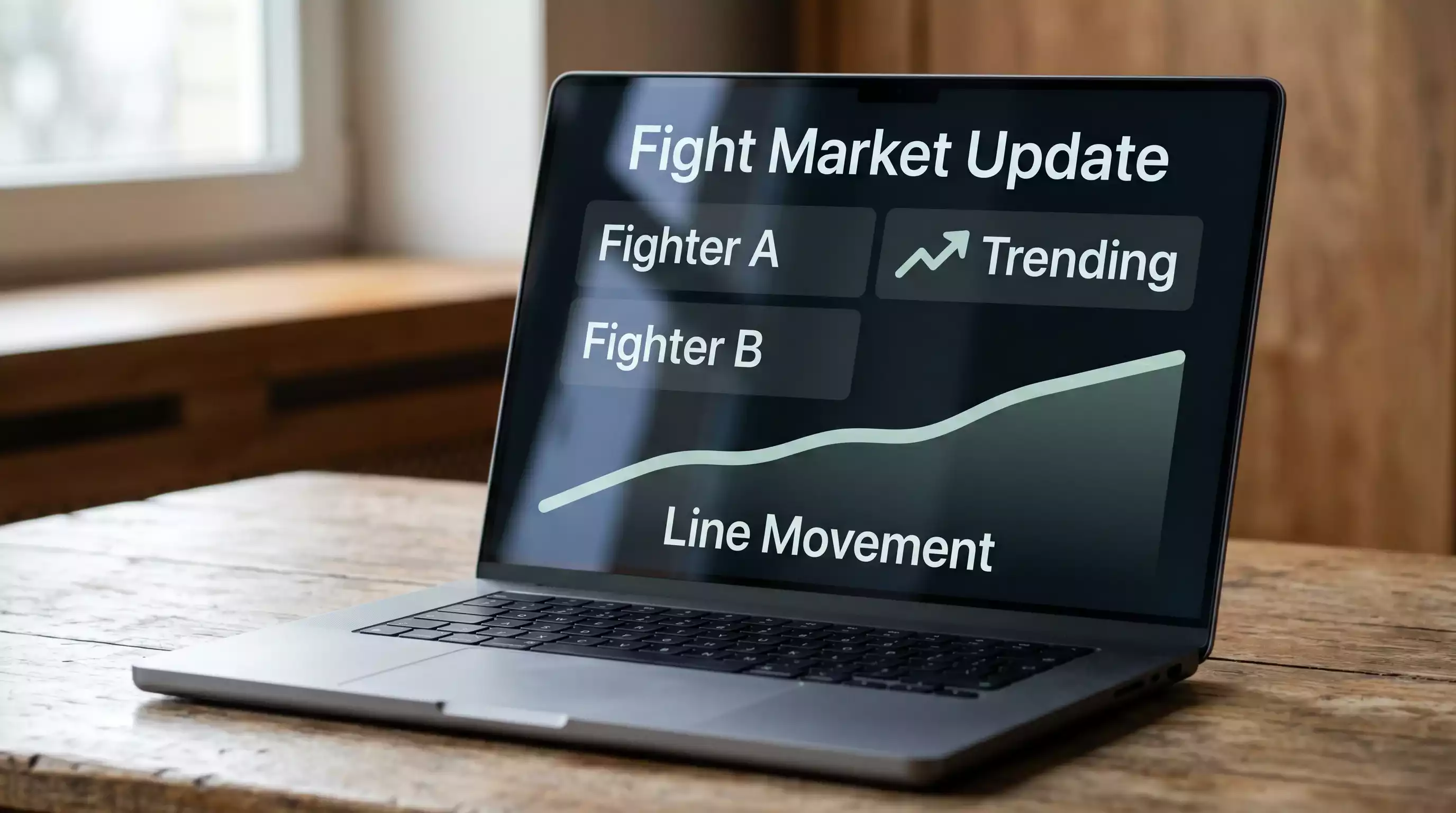
The first signal is large line movement in the absence of public information. If a fight’s moneyline opens at 4/7 favourite and drifts to 6/4 against by fight night without any visible news — no injury, no weight miss, no published analytical reasoning — that movement is being driven by money that the operators trust enough to move their lines. Sometimes that’s sharp analytical money; sometimes it’s something less savoury. The signal doesn’t tell you which, but a 60-percentage-point swing on a moneyline without a story is unusual.
The second signal is unusual method or prop activity. If most of the smart money on a fight is flowing into a specific prop market — say, “Fight ends inside Round 1” at heavy volume — when the underlying matchup doesn’t obviously justify that prop being the highest-confidence position, the pattern is worth noting. Operators see these patterns at aggregate scale and trigger alerts; retail punters can see the line movement on the specific prop and form their own questions.
The third signal is fighter-specific news that doesn’t match the betting pattern. A fighter who’s reportedly in great form, healthy, and well-prepared shouldn’t be drifting on the moneyline. When the public information says one thing and the line says another, somebody else knows something the public doesn’t. Sometimes that something is innocuous (private injury, camp difficulty); sometimes it isn’t.
None of these signals proves corruption, and none should be the basis for placing a bet you wouldn’t otherwise place. They’re flags for caution — reasons to pass on a fight rather than reasons to bet on it. The integrity-protection framework that surrounds UFC betting through regulated UK channels is what catches the cases where corruption is real; the broader context of UFC betting UK regulation covers how this protective infrastructure connects to the wider consumer-protection framework.
The bottom line on integrity for UK UFC bettors
Match-fixing in MMA is rare relative to other sports but real. The Dulgarian case in November 2025 is the cleanest UFC example in years. The integrity-monitoring infrastructure exists precisely to catch these cases, and it caught Dulgarian fast enough that UK punters who held positions on the bout got their money back rather than losing it on a compromised event.
The protection is conditional. It exists for UK customers betting through regulated channels. It largely doesn’t exist for the £16.6 billion of UK gambling handle that flowed offshore in 2025. The structural difference between regulated and unregulated UFC betting isn’t just about consumer dispute resolution or self-exclusion access — it’s also about whether the integrity-detection chain that catches match-fixing has any mechanism to refund you. For UK punters who care about the cleanliness of the market they’re betting on, the integrity infrastructure is one of the most concrete reasons to stay inside the regulated channel.

Will I get my UFC bet refunded automatically if integrity issues are confirmed?
On UK-licensed operators that have integrity refund provisions in their terms of service — which includes most major UKGC licensees — yes, typically. When IBIA or IC360 confirms suspicious activity on a UFC fight and the relevant sporting authority takes action, the operator usually voids open positions and refunds settled bets to the original stake. The exact mechanism varies by operator, and the relevant terms are normally in the Sports Rules or Integrity Provisions section. Offshore operators rarely offer equivalent refund protection.
How often does IBIA flag UFC fights specifically?
Rarely. The 2025 IBIA reporting captured 300 alerts globally across 80+ sports, with MMA appearing once in the confirmed corruption data — the Dulgarian case at UFC Vegas 110. Across a calendar of approximately 500 UFC fights per year, that’s a single-digit percentage of fights being flagged with confirmed issues, and the rate has been broadly stable across recent years. UFC betting markets are by global standards relatively clean, partly because of the integrity infrastructure and partly because the structural incentives in MMA make sustained match-fixing harder than in some other sports.
Written by the editors at bet on ufc Fight.