UFC Pick’em Fights Betting UK: Even-Money Value
 Available in US
Sizing Stakes on UFC Pick’em Coin-Flip Lines
The first pick’em I ever lost taught me more than the next ten favourites I cashed. Both fighters were priced 10/11. I bet what I thought was the obvious side, watched a tactical first round, and then the wrong man landed one counter and ended it. The bet was gone — but the lesson stayed. A UFC pickem fights betting market strips away every comfort you get from price. There is no chalk to lean on, no underdog story to romance. Only the matchup.
That is exactly why I treat pick’em fights as the cleanest classroom in the sport. When the bookmakers can’t separate two men by price, your edge has to come entirely from reading the fight better than the market did. No padding, no margin for soft analysis. You either see something the line missed, or you pass.
This piece is about that category of bout — the true even-money fight — and how UK bettors should approach it. We will cover what makes a line genuinely pick’em rather than just close, where the small edges actually hide, which divisions throw up these matchups most often, the behavioural traps that catch most punters, and finally how to stake them sensibly. You will not find a system that turns 50/50 into 60/40. You will find a framework that stops you turning it into 40/60 by accident.
What actually counts as a Pick’em
Plenty of fights look pick’em without being one. Walk into a UK shop on the day of a fight card, see a 4/5 vs Evens line, and the temptation is to call it a coin-flip. It isn’t. The market has separated the two men by a meaningful amount, and you are paying retail.
A true pick’em sits inside a narrow window. The classic shape is 10/11 on both sides — meaning a £11 stake returns £10 in profit on either fighter. That double-priced market exists because the book has to bake in its margin somewhere, and when the underlying probabilities really are 50/50, the cleanest way is to price both fighters identically below evens. The implied probability on each side works out at roughly 52.4%, with the gap to 100% being the overround.
Compare that to 5/6 on both sides. That shape — implying about 54.5% each — tells you the operator has built in slightly more juice, usually because liquidity is thinner or the model has lower confidence in either fighter. The 5/6-5/6 fight is still a coin-flip in opinion, but a worse one in price. The difference of about two percentage points per side sounds tiny. Over a hundred bets at level stakes it is the difference between a small grind upward and a slow leak downward.
There is a third pattern I see fairly often in the UFC: 21/20 against Evens. Technically not symmetrical, but functionally a pick’em where one fighter has crossed marginally onto the favourite line. Treat that as pickem behaviour for analysis, but understand the book has cast a vote — they think one man is the marginal pick, even if they won’t commit much price to it.
Where the edge actually hides
Here’s the uncomfortable truth about pick’em markets: most of them are correctly priced. UFC favourites win in roughly 65 to 70 per cent of bouts across a ten-year sample, which tells you the operators are excellent at separating men by ability. When they can’t separate two fighters, it’s usually because the data genuinely doesn’t lean either way. Going in expecting to find a 60/40 hiding behind a 50/50 means you’ll force value that isn’t there.

That said, the edge is real — it just lives in places that aren’t obvious to the casual reader. The first is style mismatch. A pure striker priced 10/11 against a wrestler priced 10/11 is not actually a 50/50 fight if you know how each man reacts to the other’s primary tool. If the striker has a takedown defence rate above 75% and the wrestler has shown nothing on the feet against high-volume strikers, the market is collapsing two different fights — wrestler’s path to victory, striker’s path to victory — into one symmetric line.
The second is the matchup history of each man’s recent opposition. Bookmakers price the fighters; sharper bettors price the matchups inside the fighters. If one man’s last three opponents averaged a 33.3% KO/TKO rate finish and your reading of the new opponent suggests he is below that threshold, you have a small edge that the line cannot show, because the model is averaging across a wider opponent pool.
The third is timing — line movement before the fight. If a true 10/11-10/11 opens and ends up 10/11-10/11 with no drift in either direction over the final 72 hours, the market consensus is genuine. If it opens 10/11-10/11 and drifts to 5/6 vs Evens by fight night, the smart money has spoken. Following that money is a defensible strategy. Ignoring it and betting the static side because “it’s still pick’em on my book” is how you bet against sharp opinion.
The divisions where pick’ems live
You won’t see two heavyweights at 10/11 a side very often, and there’s a reason. One-punch power means the variance between fighters is enormous; the model is almost always confident that one man finishes the other inside a round or two. That confidence translates into price separation. The same is broadly true of women’s strawweight, where size and reach edges tend to be visible early.

The pick’em hotspots in 2026 are bantamweight and lightweight. Both are deep, both run on volume and skill rather than power, and both have rosters where the top 15 are tightly bunched on Significant Strikes Landed per Minute and grappling output. When the bookmaker tries to separate the eighth-ranked bantamweight from the tenth, he often can’t justify more than a 5% gap in implied probability — and that gap quickly disappears once the overround is factored in.
Flyweight throws up an interesting variation. Men’s flyweight has the highest favourite winrate of any UFC division — favourites have won about 77% of bouts since 2020 in a sample around 30-8-1. That sounds anti-pick’em, but it actually creates a sub-category of true coin-flips: when two flyweights are matched at similar career stages, the line opens close to even because the model can’t tell who has the favourite role. Those rare flyweight pick’ems are the ones I watch most carefully, because the division generally rewards the better technical fighter rather than the lucky puncher.
Featherweight and welterweight throw up pick’ems less often. Both have champions and contenders with clearly separating tools — wrestling against southpaw striking, length against pressure — and the bookmakers’ models tend to commit to a side.
The psychology trap in even markets
Pick’ems are where the worst bets I see get placed. Watch any UK forum on fight week and you’ll see the same pattern: a punter looks at 10/11 on both sides and convinces himself one of them is “obviously” the right pick. The convenient mental shortcut is that an even line “must be wrong” — otherwise the bookmaker would have separated them. From there it’s a short hop to overconfidence. The pick’em line gives the player permission to back his gut at a fair price, and that combination is dangerous.

There’s also a structural reason these markets attract bad money. UK punters who track favourite versus underdog winrates sometimes notice that a 65–70% favourite rate doesn’t tell you much about a 10/11 line, and they slide into pick’ems looking for ROI. It can be done, but only with a process — not with affinity for one fighter’s story.
The wider point about player behaviour in even markets matters too. Grainne Hurst, CEO of the Betting and Gaming Council, summed up part of the migration to unregulated sites this way: “There are a range of reasons why players move to the black market: better odds, alternative payment methods like Crypto and players who have self-excluded.” Pick’em markets are precisely the kind of bet where punters convince themselves they need a fractionally better price — a chase for a tiny implied probability edge — and that chase is what pushes some across regulatory boundaries they shouldn’t cross.
The discipline is to accept that pick’ems are coin-flips by definition until you find a specific, articulable reason they aren’t. “I just have a feeling about Fighter A” is not articulable. “Fighter A defends 78% of takedowns and Fighter B has scored 60% of his career wins through takedowns” is articulable. The first opinion gets you a 50% winrate at a sub-2.0 price, which is a losing bet. The second can be a real edge.
Sizing the bet when the price is even
Stake sizing on pick’ems should be lower than on your high-confidence positions, not higher. The temptation is the opposite — punters reason that a 10/11 line is “fair”, so the natural unit can be larger. That’s the wrong frame. The price being fair doesn’t mean your read is high-conviction; it means the market has expressed maximum uncertainty about the outcome. Your edge, if you have one, is by definition narrow.
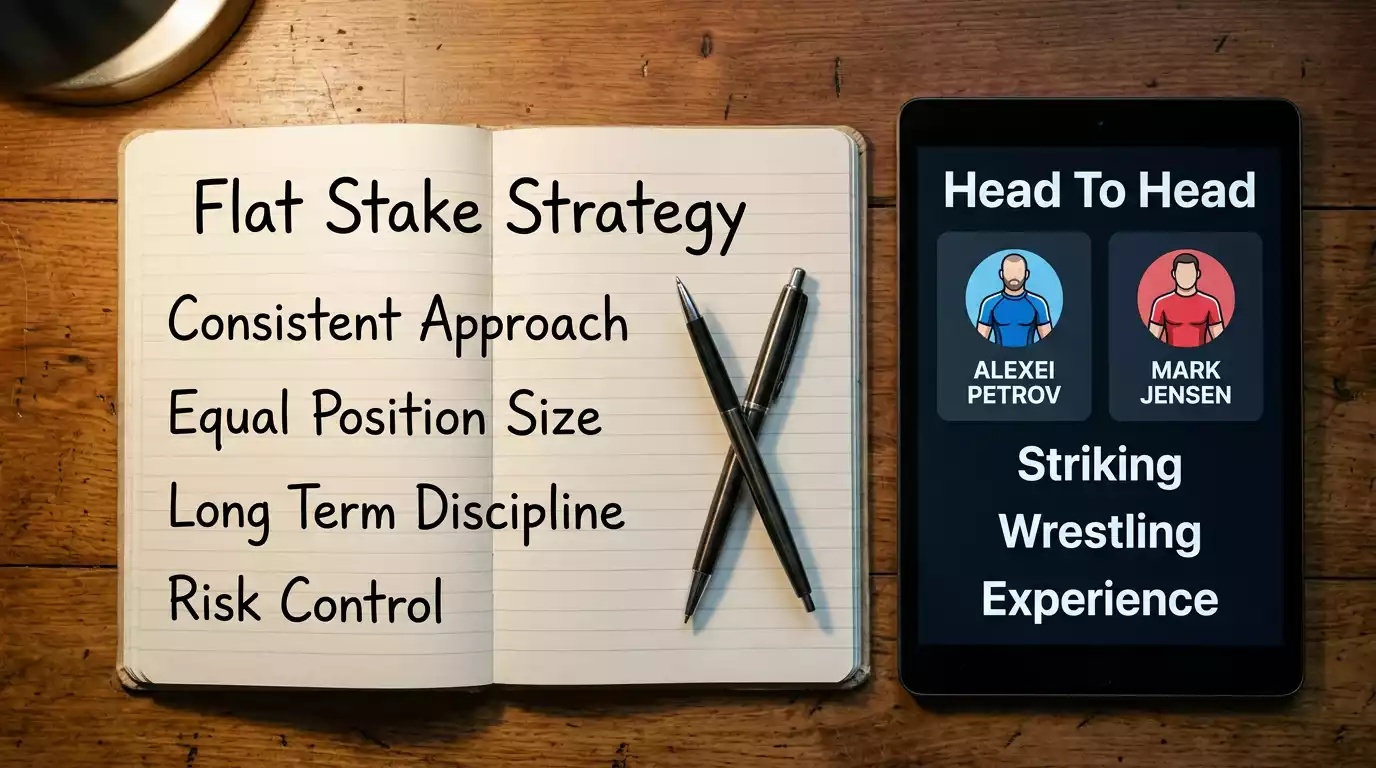
Flat stakes work best in this market. Pick a unit — 1% of bankroll is a sensible benchmark for recreational UK punters — and stick to it across pick’em positions. The reason is mathematical: if your real edge on a coin-flip is something like 53% to 47% (which is already a strong read), then any kind of progressive staking magnifies variance without meaningfully improving long-run return. Flat staking gives you the longest runway through the inevitable cold streaks.
The other discipline is volume control. Pick’ems are seductive because they feel like fair fights, and on a typical UFC card with 12 fights you might see two or three pickem-shaped lines. Betting all of them at 1% each is fine. Betting all of them and adding the favourites you “like” is not — you’ve turned a focused pickem strategy into a card-coverage strategy. The two don’t mix.
One last note on parlays. Stacking pick’ems into a multi might look mathematically appealing — two 10/11s combined gives you roughly 4.0 in decimal, an attractive ticket. The problem is that the joint probability sits around 27%, which is exactly what 4.0 implies. You haven’t manufactured edge; you’ve just compressed two independent coin-flips into one. If neither single bet has clear edge, the parlay has none either.
Reading the Pick’em card going forward
The handful of pick’ems on any UFC card are the bets that separate the disciplined UK punter from the one who chases value he can’t define. Treat them as the hardest market on the slate, not the easiest. The price symmetry is the bookmaker’s confession that he can’t decide — and that’s a confession worth taking seriously before assuming you can.

My working approach is simple. Read the matchup first, ignore the price. Build my own opinion of who wins and roughly how often. Then check the line. If my read says one man wins 55% of the time and the line is 10/11-10/11, there’s a small edge worth a unit. If my read says 51-49 either way, I pass. Flat stake, no chasing, no parlay stacking. Over a fight calendar that takes in 13 PPVs and around 30 Fight Nights in 2026, the pick’ems will come round often enough.
The other thing pick’ems train you for is the rest of your betting. Once you can read a coin-flip line and resist the urge to force opinion onto it, the bigger separations — the 4/5s, the 5/2s — become much easier to evaluate. You stop seeing prices as invitations and start seeing them as estimates.
Are pick’em fights more likely to go the distance in the UFC?
Slightly, but the effect isn’t dramatic. Pick’em fights tend to feature evenly matched skill sets, which often means neither fighter can establish the dominance needed for a finish. Around 41% of men’s UFC bouts end before the 2.5-round mark overall, and that figure drops noticeably in true pick’em scenarios — particularly in bantamweight and lightweight, where output and technique win rounds rather than power. That said, plenty of pick’ems still finish inside the distance. The shape of the matchup matters more than the price symmetry.
Why are two pick’em prices sometimes both 10/11 and never both evens?
Because the bookmaker has to bake in margin, and there’s no clean way to do that on a true 50/50 without making the prices asymmetric or going below fair value. Pricing both sides at evens (1/1) would imply 100% probability across the market, leaving the operator no margin. By offering 10/11 on both sides, the implied probabilities total around 105%, with the 5% overround being the book’s edge. It’s the standard symmetric structure for any genuine coin-flip in UK fractional markets.
Published by the bet on ufc Fight team.