
UFC Bet Types UK: Moneylines, Props and Parlays
 Available in US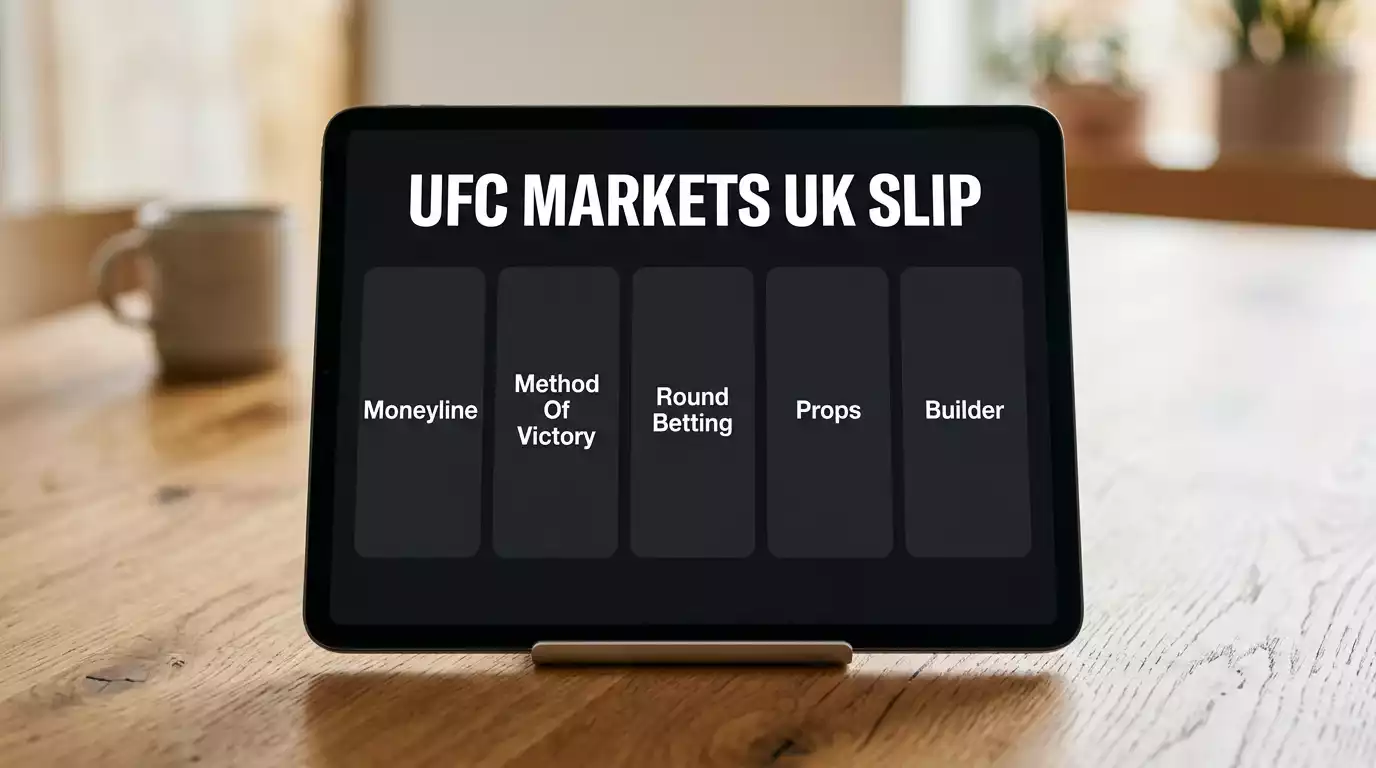
Table of Contents
- UFC Betting Markets and Sharp Money Strategies UK
- Moneyline: The Backbone Of Every UFC Slip
- Method Of Victory: Paying For Specificity
- Round Betting And The Over/Under Line
- Prop Bets: Where The Market Gets Creative
- Parlays, Accumulators, And The Maths Of Multi-Selection
- MMA Bet Builder: Building Inside A Single Fight
- Futures And Outrights: Long-Range Plays On Titles And Awards
- Live In-Play: Betting Between The Bell And The Buzzer
- Picking The Right Market For Your Read
UFC Betting Markets and Sharp Money Strategies UK
The first time I tried to count every UFC market a single British operator offered on a Numbered Event main, I gave up at sixty-two. Moneyline, method of victory, round betting, over/under rounds, knockdown props, takedown props, distance props, futures, the various builder combinations, the in-play splits — UFC has quietly become one of the most over-marketed single-bout sports on a UK slip. The global MMA handle hit $10.3 billion in 2024, growing 17% year on year, and operators have responded by stretching their market lists wider and wider on every card they price.
For a British bettor with ufc bet types uk on the search bar, the problem is not finding a market — it is choosing one. Each rank of options has its own pricing logic, its own house margin, and its own pattern of where edge lives. Some markets reward specificity. Some reward volume. Some are traps that look fun but compound the bookmaker’s overround across each leg. Nine years of building UFC books has given me a working map of which market does which job, and that map is what I’m going to lay out here.
I’ll walk through the markets in roughly the order a casual punter encounters them on a UK board — starting with moneyline, working through method of victory, round betting, prop bets, parlays, bet builder, futures, and live in-play, and finishing with a short cheat sheet for matching the market to the kind of read you actually have on a fight. This article is not a strategy guide for any one market; it is the catalogue. Strategy depth on individual markets lives in their dedicated articles. Here, you learn the shape of the menu.
Moneyline: The Backbone Of Every UFC Slip
If you only ever placed one type of UFC bet for the rest of your betting career, this is the one. The moneyline is the cleanest, the most liquid, and the one with the lowest house margin on any UK book I’ve ever priced for. It is also the market with the longest base-rate sample, which means you can actually sense-check your reads against a decade of UFC results.
The moneyline asks one question. Who wins the fight, by any method, including a referee stoppage in the dying seconds, a doctor’s stoppage, a unanimous decision, a split decision, a majority decision, a disqualification, or a corner stoppage. Anything that goes in the W column counts. Only a true draw or a no-contest sits outside the binary, and operators handle those edge cases in the small print.

The pricing is shaped by two forces. First, the underlying probability the linemaker assigns to the favourite, which is usually informed by recent form, finish history, divisional context, opponent style, weight cut record, and any late camp news. Second, the house overround, which on a moneyline is typically 4% to 7% in the UK on a Numbered Event main and slightly wider on the prelims because the public attention is lower. A typical headline favourite on UFC will sit between 4/9 and 4/6, with the corresponding dog priced between 7/4 and 11/8.
The historic base rate to keep in mind: UFC favourites land between 65% and 70% across a 10-year sample. So a fighter priced at 4/6 — implied probability 60% — is sitting slightly below the average favourite winrate, which means the price is fair to mildly generous against the long-run base. A fighter priced at 1/3 — implied 75% — is being priced above the modal favourite, which means you need a specific reason to believe this is a stronger-than-average favourite to justify the tighter price.
The structural lesson on moneyline is that “backing the favourite” is not a strategy. The favourite wins more often, sure, but is priced to reflect that. The edge in moneyline betting lives in finding spots where your model disagrees with the bookmaker’s by a meaningful margin — typically because you’ve spotted a stylistic mismatch, a weight cut concern, or a camp-news angle the market has not absorbed yet. Without that disagreement, you are paying overround for nothing.
Method Of Victory: Paying For Specificity
Method of victory is where casual bettors lose the most money on UFC without realising why. The market looks simple. For each fighter, the bookmaker offers three lines: wins by KO/TKO, wins by submission, wins by decision. Six lines total per fight. Pick the path you fancy and the price is materially better than the straight moneyline because you’re committing to a specific finish type, not just the outcome.
The arithmetic that gets overlooked: those six lines have to sum to 100% probability across all possible finishes for both fighters. The operator’s overround, which on a clean moneyline might be 5%, widens to 12% to 18% on a six-line method market. That widening is not greed. It is the mathematical cost of splitting a binary outcome across six lanes. Every step toward specificity costs you margin.
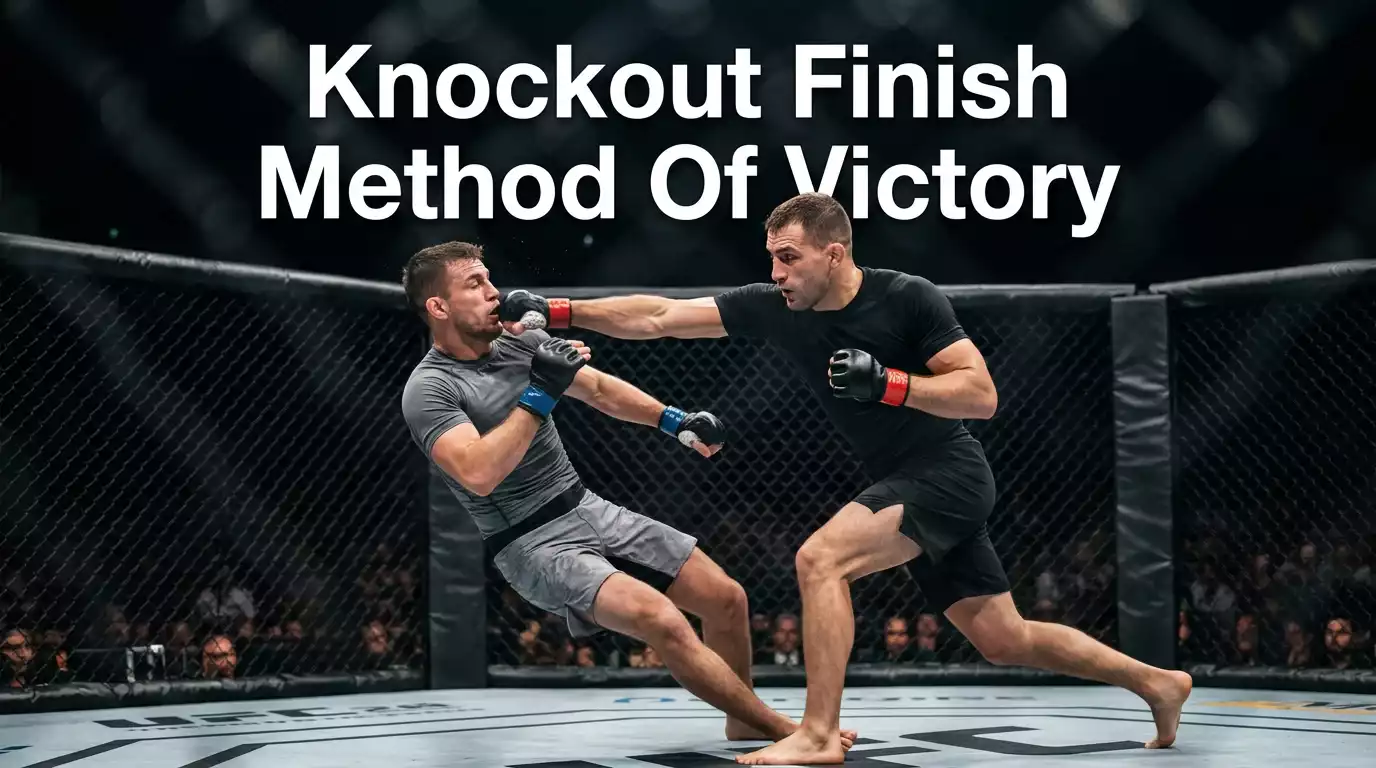
The dominant base rate for this market is the global UFC finish rate. Roughly 53% of all UFC fights end inside the distance — 33.3% by KO/TKO, 19.7% by submission — and the remaining 47% end on the scorecards. That distribution is the linemaker’s anchor. The divisional variation around that anchor is where the genuine reads sit, and we’ll see why in a moment.
Heavyweight is the dominant outlier. About 50% of all heavyweight fights end by KO or TKO, and the decision rate sits at only 28.6% — the lowest of any UFC division. When a heavyweight main event is on the card, the method-of-victory market should be visibly skewed toward KO outcomes on both sides. If it isn’t, the bookmaker has not priced the divisional adjustment cleanly, and that’s an angle. The pattern is almost as strong in middleweight and light heavyweight, just less extreme.
Flyweight is the mirror outlier. Flyweight fights end by KO at only 24.6% and by submission at 21.7%, with roughly 53% going to the judges’ decision — the highest decision rate in the men’s divisions. When you back a flyweight fighter by KO, you are betting against the divisional tide. The price will look attractive because the bookmaker has to compensate you for the divisional skew, but the underlying probability is genuinely low.
The structural play on method-of-victory is to ask yourself two questions before clicking. First: am I genuinely confident in the finish path I’m picking, or am I just being seduced by the bigger price? Second: does this division historically support this finish path? If the answer to either is “not really”, you’re paying overround for an outcome the data does not support. Method bets earn their place only when you have a directional read on how the fight ends — never as a price upgrade on the moneyline you already fancy.
Round Betting And The Over/Under Line
Round betting is the second-largest UFC market by volume on most UK boards, and it splits into two pricing shapes that operators sometimes confuse in their marketing. The first is the round-by-round market: which round does the fight end in, plus a “goes to decision” outcome. So on a three-round bout you’ll see four lines (Round 1, Round 2, Round 3, Decision); on a five-round bout you’ll see six (Round 1 through 5, plus Decision). The second shape is the over/under rounds market: the line is typically set at 2.5 rounds for three-round bouts and 3.5 rounds for five-round bouts, and you pick whether the fight ends before that line or after.
The over/under is structurally cleaner, lower margin, and closer to a binary. The round-by-round is more specific, wider margin, and is essentially a method-of-victory-by-time market.
The base rate that matters here: roughly 41% of UFC men’s fights end before the 2.5-round mark. That’s a hair below evens — which means the over/under 2.5 line on a typical three-round bout should price the “under” side around 11/10 to 6/4 depending on the divisional mix, and the “over” side similar. When you see a card where the under is priced shorter than that — say 4/5 — the bookmaker is reading a heavy finish-rate skew into the matchup, usually because both fighters have aggressive striking profiles or the division skews toward early finishes.
The divisional adjustments matter just as much here as they do on method-of-victory. A heavyweight headliner where the over/under is set at 2.5 rounds is begging for an under bet on base rates alone — 50% of heavyweight fights end in KO/TKO, mostly inside two rounds. Yet I see UK punters routinely back the over because they assume championship fighters “stay safe” early. The data says the opposite. Heavyweight finishes early and finishes hard, and the bookmaker tends to price slightly long on the under to compensate for casual money chasing the over.
Round-by-round is harder to price profitably because the granularity is so fine. The “ends in Round 1” price on a typical favourite might be 5/2, the “ends in Round 2” price 11/4, the “ends in Round 3” price 9/2, and the “goes to decision” price 6/4. Combine that across both fighters and the operator has eight or ten lines summing to 100% with an overround of 15% to 20%. Profitable round-by-round betting requires very specific reads — typically that a particular fighter has a known fast-start pattern, or a known slow-burn pattern, that the market has not absorbed.
Prop Bets: Where The Market Gets Creative
Prop bets are the long tail of the UFC market list, and they are also where operator differentiation starts to show. The two biggest UK books will offer twenty or thirty distinct props on a Numbered Event main; a smaller operator might offer five. The most common props are knockdown props (will there be a knockdown? how many?), fight-to-go-the-distance (a refined version of over/under rounds, usually with sharper pricing), takedown props (will a takedown land? how many total?), and significant-strike totals (over/under on a specific strike count).
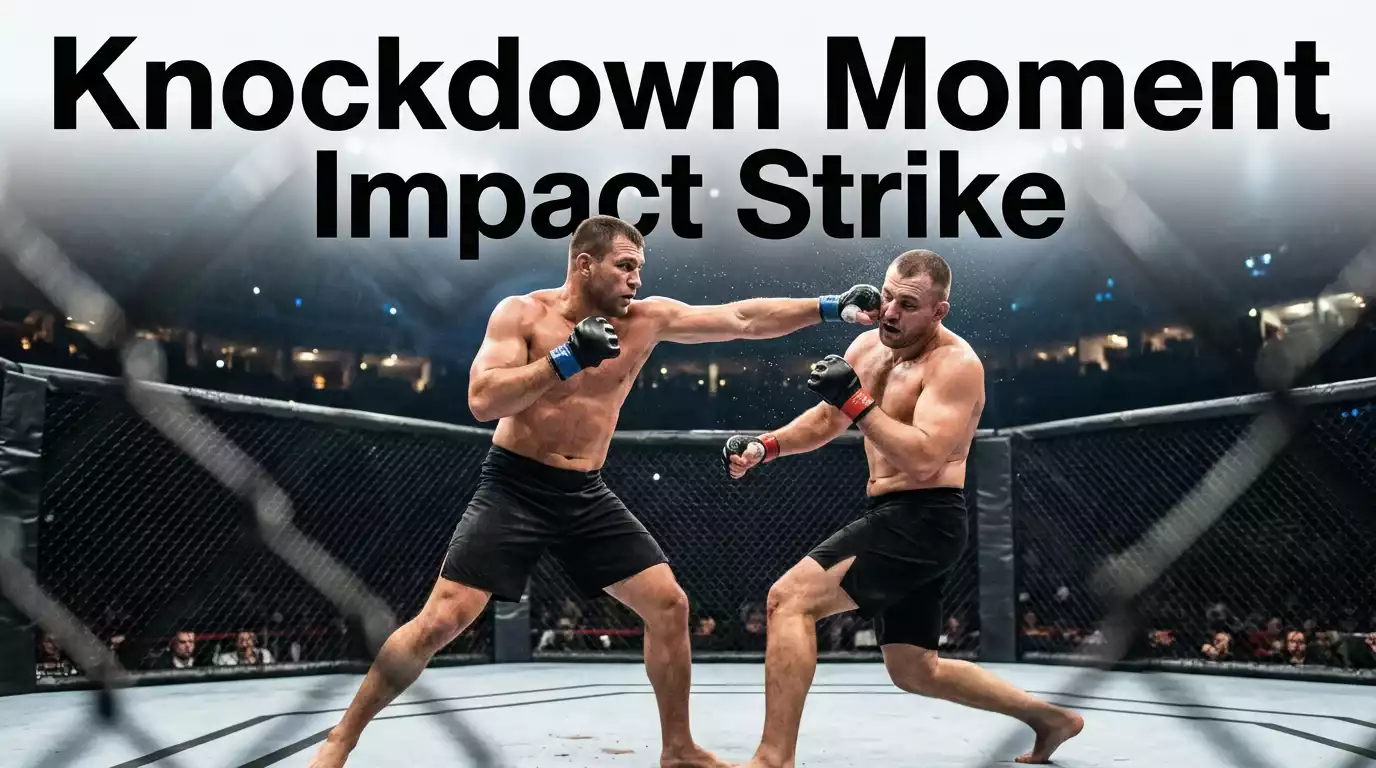
Knockdown props are popular because they feel intuitive — a knockdown is a visible, narrative event. The pricing reflects the underlying probability, which varies enormously by division and fighter style. A heavyweight bout has a knockdown probability of around 60% to 70% on average; a strawweight or flyweight bout drops to 30% or below. UK books typically price “any knockdown” between 8/13 and 11/10 depending on the matchup. The “no knockdown” price on a flyweight pick’em is genuinely interesting value if you’ve watched both fighters and neither has a knockout finish on their recent record.
Fight-to-go-the-distance is the over/under rounds market dressed in narrative clothes. It typically prices around 6/5 to 7/5 each way depending on the divisional mix. The reason to bet it instead of the rounds market is when the operator’s price on this prop is meaningfully better than the equivalent over 2.5 rounds — which happens occasionally because the two markets are priced by different desks within the operator and don’t always converge.
Takedown props depend on the wrestling profiles of both fighters. The data here is murkier because not every operator tracks it consistently, and the prop is genuinely hard to model. I tend to avoid takedown props unless I’ve watched substantial recent tape on both fighters and I’m seeing a clear stylistic skew the market has not absorbed.
UK operators are not uniform on prop availability. bet365 typically runs the widest prop list, Betway and William Hill sit in the middle, Coral and Ladbrokes run leaner. If you find a market on one UK book and not another, that is structural — it is not because the operator forgot. Books choose their prop range based on liquidity expectations, and the smaller operators stay tight to protect their book.
Parlays, Accumulators, And The Maths Of Multi-Selection
The British vocabulary for what the rest of the world calls a parlay is “accumulator” — the same product, the same maths, just a different word on the slip. You combine two or more selections into a single bet, all of which must win for the bet to pay out, and the multiplier compounds across the legs.
The maths is unforgiving and it is worth understanding it before you ever build one. Each leg has the operator’s margin baked into its price. When you compound four legs each at decimal 1.91 — that’s 10/11 fractional, with 4.8% margin per leg — the total margin against the bettor compounds to roughly 19.4% across the slip, not 4.8%. The bookmaker is not stacking your margin once; he is stacking it every leg.
This is why parlays look exciting and pay poorly on average. A four-leg accumulator at average decimal 2.00 per leg pays 16.0 times your stake. If each leg has a true 50% win probability, the slip has a 6.25% true probability of winning — meaning the fair return would be 16.0 times. Bookmakers offer that 16.0 times only because they’ve squeezed the margin into each leg’s price, so the true payout to the bettor is less than fair across the long run.
The UK-specific quirk is the single-card accumulator. Operators love it because it concentrates volume from casual UFC bettors stacking three or four “lock” favourites from one Fight Night. The single-card accumulator is the worst-priced parlay on the menu because the operator knows the casual money will chase it. If you must build an accumulator, mix cards or mix sports — the volume-weighted operator margins are slightly looser when the legs aren’t from a single event.
The honest use case for parlays is small-stake recreation with a clear understanding that you are paying entertainment value for the compounded margin. If you’re serious about UFC betting as a long-term exercise, parlays should be a fraction of your turnover, not the bulk.
MMA Bet Builder: Building Inside A Single Fight
The bet builder is the parlay’s smarter cousin. Instead of compounding selections across different fights — where the legs are statistically independent — the builder lets you compound selections within a single fight, where the legs are correlated. The operator’s model adjusts for that correlation, which means a builder priced inside one fight is not a simple multiplication of the individual leg odds.

A typical UFC bet builder leg structure: pick the winner, pick the method, pick the round. So a builder might combine “Fighter A wins” with “by KO/TKO” with “in Round 2”. The standalone moneyline at 4/6, KO method at 5/2, and Round 2 specific at 11/4 would multiply to roughly 27 times your stake. The builder will offer something tighter — perhaps 18 to 20 times — because the operator has correlated the legs and adjusted the implied probability accordingly.
That correlation adjustment is what makes the builder fascinating and tricky. A genuine model edge in the builder requires you to disagree with the operator’s correlation assumptions, not just the standalone leg odds. If you think a specific fighter ends a specific opponent specifically in Round 2 by KO at a probability higher than the operator’s correlation model implies, the builder is the cleanest expression of that view. If you’re just stacking three lines because they “feel right together”, the builder is a worse parlay than the regular kind.
UK operators vary in builder depth. bet365 was named the official sports betting partner of UFC in the US and Canada in March 2026, and the press release quoted Nicholas Smith, TKO Group’s senior vice president of global partnerships, saying that the operator brings scale, credibility, and innovation to the sports betting space. That partnership has visibly accelerated the depth of bet builder integration at the UK arm of the same operator — more leg combinations, more in-fight options, more granular correlation handling. Other UK books are quietly catching up, but the depth varies. Always check what legs the builder will let you combine before you assume a market is available.
Futures And Outrights: Long-Range Plays On Titles And Awards
Futures are bets on outcomes that resolve over a longer horizon than a single fight. The most common UFC futures on UK boards are the title outright markets — who wins the next light-heavyweight championship, who holds the welterweight title at year-end, who emerges as the lineal contender — and the year-end awards markets like Fighter of the Year, Knockout of the Year, and Submission of the Year.
The pricing on title outrights is shaped by the depth of the divisional roster and the booked schedule. A favourite in a thin division with no scheduled challenger might be 1/2 to hold the title at year-end. The same fighter in a stacked division with three scheduled defences sits more like 5/4 or 6/4. The margin on outrights is typically 15% to 25% because the operator needs to price every plausible contender and offer a long tail of generic “any other fighter” lines.
The structural lesson on futures is that they tie up your bankroll for months. A 5/4 title future paid out in nine months has different opportunity cost than a 5/4 moneyline on tonight’s main event. The implied probability might look reasonable, but the time-discounted return is not. UK operators do not pay interest on stake locked in futures, which means every future is a loan to your bookmaker at zero percent for the life of the bet.
Awards markets are more whimsical. They reward style and narrative as much as result, and the pricing is genuinely hard to model because the criteria are partly subjective. I treat awards futures as recreational. The information edge available to the average bettor is too thin to make them a serious play.
Live In-Play: Betting Between The Bell And The Buzzer
Live in-play is the fastest-growing UFC market segment by some distance. UFC events generate around 11% of all live-bet clicks across major US-Canada platforms on tournament days, and the UK pattern mirrors that — most UFC handle on a UK Saturday-night card now goes through the live market.

The live UFC menu typically includes round winner (who wins the current round), next-knockdown, next-takedown, fight-end-this-round, and method-this-round. Prices update in seconds based on what happens in the cage. The operator’s risk system is genuinely impressive: it absorbs every visible event — a knockdown, a heavy kick, a takedown — and re-prices the market on the fly.
The UK-specific quirk is that live cashout is standard across all UKGC-licensed operators. You can exit any pre-fight bet mid-fight at a price the operator calculates against the current state of the fight. Used carefully, cashout can lock in profit on a bet that’s gone your way through one round; used carelessly, it’s a habit that costs you the difference between the cashout price and the true probability of completion.
The biggest mistake on live in-play is volume-chasing — placing a bet every break in the action because the market is open and the buttons are right there. The latency on UK live markets is genuinely tight, but it’s not zero, and casual money fights that latency at a disadvantage. If you can’t articulate what you’re betting on and why, between rounds is not the moment to find out. Beyond the standard moneyline, many profitable punters find consistent value by exploring UFC prop bets like knockdowns and takedowns during major events.
Picking The Right Market For Your Read
Markets are tools. Each one is sized for a specific kind of read, and matching the read to the market is more than half of profitable UFC betting. Here is the short version of how I’d map them.
A directional view on who wins, with no specific method or round read, belongs on the moneyline. That market has the lowest house margin and the cleanest base rate to test against. A view on how the fight ends — by what method, in what timeframe — belongs on method-of-victory or over/under rounds. Pick whichever is closer to your actual read. A view on the pace of the fight — explosive or measured — fits the over/under rounds market with no need for method specificity. A view on a single specific event — a knockdown, a takedown, going the distance — is a prop play and lives there. A view that combines an outcome with a method with a round, where you’ve thought hard about the correlation, is what the bet builder was built for. Anything else is recreation.
If you want to drill harder into one specific market, the cleanest place to start is moneyline strategy because the data is widest and the base rate is most reliable. I’ve put the long-form walk-through into a dedicated UFC moneyline strategy guide for UK bettors that goes through the favourite-versus-underdog framing, the divisional adjustments, and the staking discipline that makes the market actually profitable rather than just intuitive. Maximize your returns by following the strategies outlined on our trusted UFC betting analytics portal.
Which UFC bet type carries the lowest house edge for UK bettors?
The moneyline. Across UK-licensed operators, the moneyline on a UFC main event typically runs an overround of 4% to 7% — the lowest of any UFC market. Method of victory widens to 12% to 18%, round-by-round sits at 15% to 20%, and accumulators compound the per-leg margin across each selection. If you want the cleanest single-bet pricing, the straight winner market is where to start.
Can I combine method of victory and round in a single UFC bet?
Yes, through the bet builder. Standalone, method of victory and round-by-round are separate markets and you’d have to bet them as two slips. The MMA bet builder lets you combine ‘Fighter A wins by KO/TKO in Round 2’ into a single correlated leg, and the operator prices the combined leg as one number that accounts for the correlation between the two outcomes. Builder depth varies between UK operators, with bet365 typically offering the widest combinations.
Do all UK UFC bookmakers offer the same prop bets?
No, and the variation is large. The two biggest UK operators on UFC will typically run twenty to thirty distinct props per Numbered Event main — knockdowns, takedowns, distance, significant strikes — while smaller UK books may run five. Smaller operators stay tight to protect liquidity. If a prop you want is not at your usual operator, it’s worth checking another UK book, but always confirm the operator holds a valid UKGC licence before opening an account.
Written by the editors at bet on ufc Fight.