
UFC Favourite vs Underdog Winrates UK: ROI Stats
 Available in US
Table of Contents
Historical UFC Underdog Winrates and Betting ROI
There’s one statistic in UFC betting that does more work than any other: across roughly a decade of data, ufc favourite vs underdog matchups resolve in the favourite’s direction about 65 to 70% of the time. Underdogs win 30 to 35%. That single fact, taken seriously, reshapes how you read every line on every UFC card — because it tells you what the market actually thinks “favourite” means.
Most casual UFC bettors carry one of two wrong models in their heads. Either favourites win nearly every time (in which case backing them at 4/7 or shorter feels like printing money), or upsets are common enough to make underdog backing a profitable habit (in which case 3/1 dogs look like value on every card). The data says neither view is right. Favourites win about two thirds of the time, which means underdogs win about one third — frequent enough that surprises are normal, infrequent enough that backing them indiscriminately is a losing strategy.
This piece walks through what the 10-year UFC winrate data actually says, where the rate breaks down by favourite size and division, the underdog ROI myth that costs casual punters real money, and how to use implied probability against real winrate to find positions that have positive expected value rather than positions that just feel good after the fight.
The baseline winrate across the full sample
Across the modern UFC era, favourites win in the 65 to 70% band depending on the specific sample window and how “favourite” is defined. Closing-line favourites — the side the market settled on after fight-week money came in — win at the higher end of that band, around 68 to 70%. Opening-line favourites win slightly less, around 64 to 66%, because the opening line sometimes reflects model output before sharp money corrects.
That 65 to 70% band has been remarkably stable. It hasn’t moved meaningfully across the last decade, despite the sport adding new divisions, expanding the roster, and changing the matchmaking patterns. The persistence tells you something important: the bookmakers’ pricing models are genuinely good at separating men by ability. The 65 to 70% rate isn’t a market accident — it’s the actual rate at which the better fighter wins UFC bouts.

What that means for the implied-probability calculation: a favourite priced at 1/2 (implied probability 67%) is being priced almost exactly at the cross-divisional rate. The market isn’t claiming any specific edge — it’s just telling you “this is the side that wins in the typical UFC matchup”. A favourite priced at 4/6 (implied probability 60%) is being treated as marginally less of a favourite than the cross-divisional norm; one at 2/5 (implied 71%) is being treated as marginally stronger.
The corollary number is the underdog rate. Across the same sample, underdogs win 30 to 35% of bouts. That’s higher than casual punters expect — the perception is that upsets are rarer than they actually are. One in three UFC fights ends with the underdog winning. Across a card of 12 fights, you should expect three or four underdog wins on average, not one or two.
The heavy favourite skew and where the curve bends
The 65 to 70% rate isn’t flat across all favourite prices. It bends. Heavy favourites — those priced at 1/4 or shorter, implying probability above 80% — actually win about 80% of the time, not 65 to 70%. The market’s separation of “this is a clearly better fighter” from “this is a marginally better fighter” is real and corresponds to actual outcomes.
What that means is that the 65 to 70% average across all favourites is itself a blend. Heavy favourites win at 80%. Mid-tier favourites (priced 4/7 to 4/9) win at the cross-divisional average around 67 to 68%. Light favourites (4/5 to evens) win at lower rates, around 55 to 60%, because the market is admitting it can barely separate the two fighters.
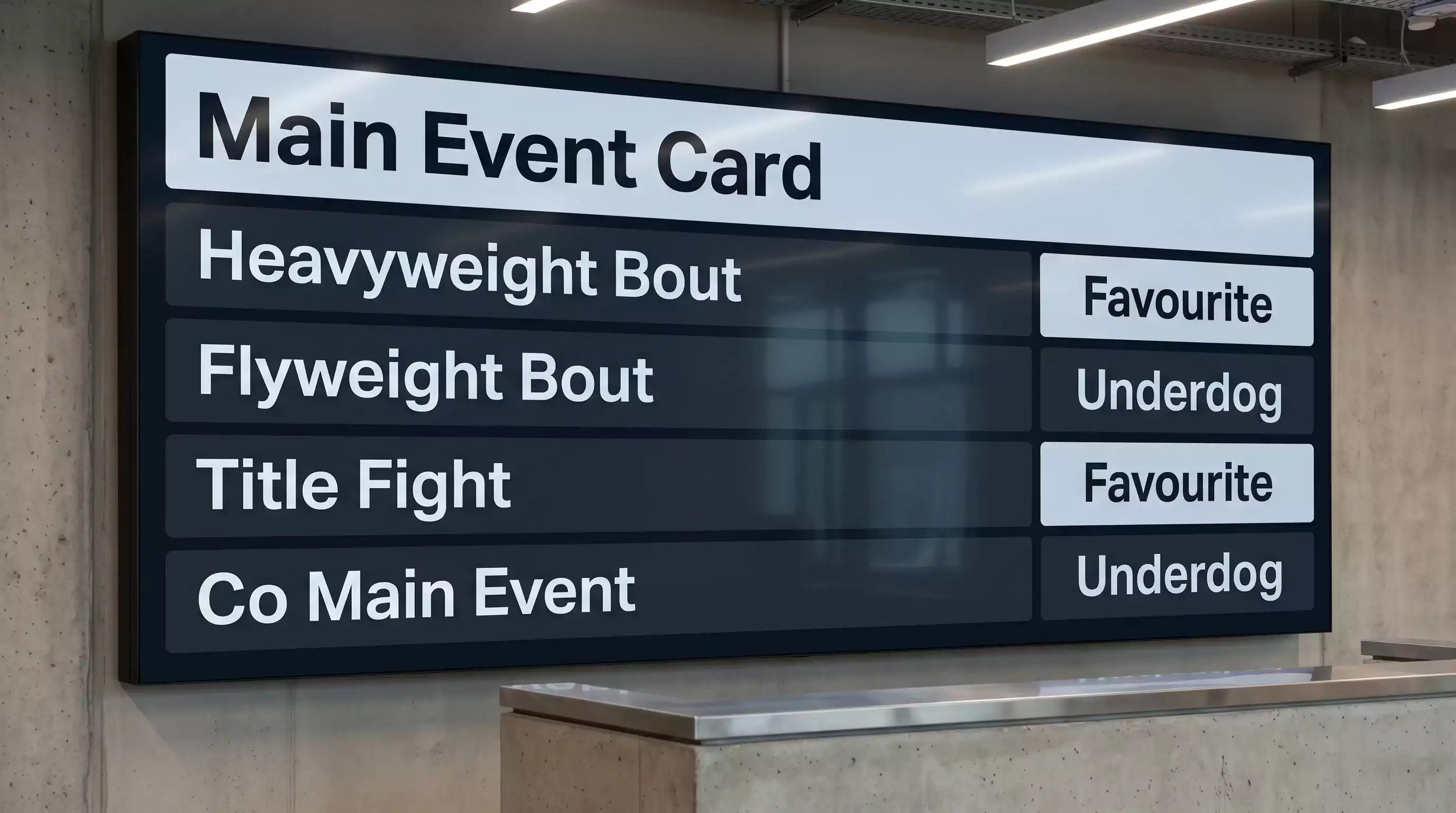
For the punter that creates a specific decision tree. Heavy favourite positions are highly predictable but offer low return per bet. If you back a 1/4 favourite to win at 80% probability, you need to win four times to recover one loss in pure cash terms — the math is tight, and any deviation from the 80% rate (which happens within sample variance) eats your edge fast. Heavy favourite betting is not “easy money”; it’s an exercise in volume discipline.
Light favourite positions are where the rate gets fuzziest. A favourite priced at 4/5 implying 55% probability is being told by the market “barely separated from a coin-flip”. If the real probability is actually 55%, you’ve got fair odds — no edge either way after the operator’s margin. If the real probability is 60%, you have edge. If it’s 50%, you’re betting at a loss. The skill at this price band is determining which scenario applies, and that takes more analysis than blanket backing of favourites.
The divisional differences that reshape the average
The 65 to 70% cross-divisional average is itself an average across very different divisional patterns. At one extreme, men’s flyweight favourites win about 77% of the time — well above the cross-UFC norm — because the division rewards pace, technique, and sustained pressure, which are qualities the better fighter can reliably deploy. At the other extreme, heavyweight favourites underperform the cross-divisional rate, because the one-punch KO variance means underdogs land the fight-ending shot more often than at other weight classes.
This divisional skew has direct betting implications. A 4/7 favourite at flyweight is implicitly being underpriced relative to the divisional rate — the implied probability of 64% is below the actual flyweight favourite rate of 77%. The same 4/7 favourite at heavyweight is fairly priced or slightly overpriced relative to the divisional reality.

The lightweight and bantamweight divisions sit close to the cross-UFC average. Welterweight and featherweight produce favourites at slightly above-average rates, around 70 to 72%, because both divisions have a high concentration of veteran fighters whose patterns are well-modelled. Heavyweight, light heavyweight, and women’s bantamweight sit slightly below average, around 60 to 65%.
The practical use of divisional rates is to inform position sizing. Equal-implied-probability favourites should not be backed at equal stakes when one is at flyweight and one at heavyweight — the flyweight favourite carries more real probability behind the same price, so its position should be larger. Conversely, equal-implied-probability underdogs at heavyweight carry more real probability than at flyweight, so heavyweight dogs are the better candidates for backing when the matchup justifies.
The underdog ROI myth
One of the most persistent myths in UFC betting is that “always backing the underdog” produces positive ROI over the long run. The argument goes: dogs win 30 to 35% of the time, the average dog pays at fractional odds equivalent to roughly 2.5/1, and 30% wins at 2.5/1 returns 75 pence on the pound, which after factoring in stake recovery yields a small positive ROI.
The math is broken in two places. First, the “average dog pays 2.5/1” claim is misleading — the population of UFC underdogs spans from 6/5 short dogs to 8/1 long shots, and the winrate across that range is not uniform. Short dogs (6/5 to 2/1) win at much higher rates (35 to 45%) than long shots (5/1 or longer, winning at 8 to 12%). The aggregate “underdog winrate” averages across this distribution, but ROI calculations have to be done at each price level.

Second, and more important, the operators price the overround into every line. A 2.5/1 underdog on the board has an implied probability of around 28.6%. If real winrate at that price band is 30%, the punter’s edge is tiny — maybe 5% — and disappears completely once you factor in the operator’s margin (typically 5 to 8% on UFC moneyline markets). The arithmetic doesn’t sustain a “back all dogs” strategy.
What does sustain a profit is selective underdog backing — finding the specific underdogs where the real probability exceeds the implied. Some heavyweight underdogs with one-shot power. Some lightweight underdogs against favourites with documented chin issues. Some flyweight underdogs whose recent form is misread by the model. None of these are general strategies. They’re specific reads. The temptation to skip the read and just back every dog at every price is the trap — it converts the 30 to 35% underdog winrate into a slow grinder of bankroll, because the market price already accounts for that winrate plus a margin.
Using implied probability as your working tool
The framework for using these rates in practice is straightforward: every line carries an implied probability, and the bet is positive expected value when your read of real probability exceeds the implied number plus the operator’s margin.
Convert any fractional price to implied probability with simple arithmetic: for a price written as X/Y, implied probability is Y / (X + Y). So 4/7 implies 7 / 11 = 63.6%. 2/1 implies 1/3 = 33.3%. 1/4 implies 4/5 = 80%. The decimal version is even simpler: 1 / decimal odds. Decimal 1.57 implies 1/1.57 = 63.7%.

Now compare to the divisional and price-band rates from the data. A 4/7 favourite at flyweight implies 63.6%, when the divisional rate at that price band is closer to 75%. Edge: 11 percentage points. A 4/7 favourite at heavyweight implies 63.6%, when the divisional rate at that price band is closer to 62%. Edge: roughly nil, possibly negative after margin. Same price, completely different bets.
This framework is what separates analytical UFC betting from the “I just have a feeling” approach. The implied probability is the operator’s estimate. Your edge — if any — comes from disagreeing with that estimate based on evidence. Working in implied probability also gives you a quick read on whether a line has moved against you. For deeper background on how the moneyline market behaves at different price bands, the broader piece on UK moneyline strategy and when chalk earns its price covers the structural mechanics.
What 10 years of data doesn’t tell you
The 10-year data is a starting point, not a finishing point. It tells you the population statistics for UFC outcomes. It doesn’t tell you which specific fight in front of you next Saturday breaks the population pattern, and that specific fight is the only one your bet actually depends on.
What the data does give you is a defensible reference point. When you find yourself thinking “this favourite at 4/7 is a lock”, the 65 to 70% historical rate is the reality check — 4/7 implies 63.6%, very close to the historical norm, meaning the market doesn’t see anything unusual about this favourite. If you genuinely believe the fighter is a much stronger favourite than that, you should be able to articulate why your read deviates from the population average. “Because I like him” doesn’t qualify. “Because he has documented 80% takedown defence against an opponent who scores 60% of wins via takedown” does.

The other use of the data is patience. UFC seasons produce variance. A 65 to 70% favourite rate means underdogs win 30 to 35% — meaning across a 12-fight card, three or four underdogs winning is the expected outcome, not an upset card. Treating the normal underdog-win frequency as a string of upsets is how punters lose discipline. The variance is built into the rate. Plan for it, size positions to survive it, and read each fight on its own merits rather than as a piece of a “favourites are winning tonight” or “the dogs are eating” narrative. Neither narrative exists. The base rate is what it is, and the next fight is independent of the last one.
Has the UFC favourite winrate changed significantly since 2020?
Not significantly. The 65 to 70% cross-divisional band has held steady across the last decade, including through the 2020–2022 period when matchmaking patterns changed due to schedule disruption. Some divisions have drifted — men’s flyweight has trended slightly higher, heavyweight slightly lower — but the aggregate rate has stayed within its historical range. The stability is a reflection of how good the bookmakers’ pricing models are at separating fighters by ability; the rate hasn’t moved because the underlying skill of the operators’ models hasn’t shifted materially.
Are UFC women’s divisions more favourite-friendly than men’s?
It depends on the division. Women’s flyweight and bantamweight favourites win at rates broadly comparable to the men’s cross-divisional norm — around 65 to 70%. Women’s strawweight has historically produced slightly higher favourite winrates, often above 70%, because the division has a relatively shallow top tier and the matchup gap between contenders and challengers is wider than at higher weights. Women’s featherweight has too small a sample to draw statistical conclusions. As ever, divisional rates are population statistics, not predictions about individual fights.
Published by the bet on ufc Fight team.