UFC Bet Builder UK: Stacking Same-Fight Markets
 Available in US
Table of Contents
UFC Bet Builder Rules and Correlation Value Traps
Bet builders started life as a football product. The first UFC builders I tried four years ago were limited and clumsy — most combinations rejected for unspecified correlation reasons, prices that did not survive a second click, and a UI that clearly came from a Premier League weekend. Today, the major UK operators have separate MMA bet builders with their own correlation rules and pricing models, and the result is a genuinely interesting market that deserves a different read from how you would think about a same-game football multi.
This piece is about UFC bet builders specifically: how same-fight combinations price, where correlation works for you and against you, and the value traps that pretend to be promotions. I will keep the distinction between builders and accumulators sharp throughout, because the two products behave differently in maths and in strategy. Builders combine selections within one fight. Parlays combine selections across fights. The arithmetic looks similar but the underlying correlation is completely different, and that difference is what makes builders simultaneously the most attractive and the most punishing same-fight product on a UK UFC card.
Inside one fight versus across fights
A bet builder stacks selections on a single UFC fight. A parlay stacks selections across multiple fights. The mechanical difference matters because the events inside one fight are heavily correlated, while events across separate fights are usually independent (or close to it).
Take a four-leg same-fight builder: Fighter A to win, Fighter A by KO/TKO, Total knockdowns Over 0.5, Fight does not go the distance. These four selections are not independent. If Fighter A wins by KO, then by definition there is at least one knockdown and the fight does not go the distance. The “true” combined probability of the four legs is approximately equal to the probability of the most restrictive single event — Fighter A by KO/TKO. If A wins by KO 35% of the time, the joint probability of the four-leg builder is also roughly 35%.
The operator knows this and prices accordingly. The four-leg builder will not multiply 0.65 × 0.40 × 0.55 × 0.55 to give you 7.9% implied (decimal 12.66). Instead, the operator’s correlation engine will collapse the correlated legs and price the builder at something close to the underlying single-leg KO price — maybe 11/4 (decimal 3.75) instead of the naive multiplication of 12.66. Knowing this is the difference between bettors who use builders well and bettors who think they are catching a price that does not exist.
Typical combinations and how they price
The three most common UFC bet builder shapes on UK apps are: Winner + Method, Winner + Round, and Winner + Total Takedowns Over/Under. Each combines the moneyline with one specific structural read.
Winner + Method is the most popular. Fighter A to win + A by KO/TKO is essentially a long-form expression of the standalone method bet, and the operator prices it within a couple of percent of the standalone method line — sometimes shorter because of correlation, sometimes longer because of promo pricing. About 53% of UFC bouts end inside the distance, with KO/TKO at 33.3% and submission at 19.7%, so the underlying base rate gives you a sense of whether the operator’s combination is sharply priced.
Winner + Round (or Winner + Over/Under Rounds) is the duration combination. Fighter A to win + Under 2.5 rounds tells you the bettor believes A wins by finish in the first two and a half rounds. The combination prices similarly to Fighter A by KO/TKO + Fighter A by submission added together, because those are the only methods that produce Under 2.5 wins for A. The decimal price is typically 1.5 to 1.8 on a sharply-favourite combination, 3.0+ on a co-main co-favourite combination, and varies widely depending on the specific moneyline and matchup. About 41% of UFC men’s bouts end before the 2.5 round mark, so this combination has a meaningful base rate to anchor against.
Winner + Total Takedowns Over/Under is the matchup-specific combination that rewards research. A wrestler-favoured matchup with A to win + Total Takedowns Over 2.5 prices generously when both fighters’ historical takedown profiles support the line; it prices conservatively when the operator has identified the wrestler as the strong favourite already.
Correlation rules — what UK operators allow and refuse
Every UK operator has a list of combinations the builder will not accept. The list is rarely published in full, but the patterns are consistent across the major books.
Allowed nearly everywhere: Winner + Method, Winner + Rounds, Winner + Total Takedowns, Winner + Goes the Distance, Winner + Knockdown markets. These have moderate correlation that the operator’s pricing model can handle.
Refused or aggressively re-priced on most apps: Method-by-KO + Goes-the-Distance (these are mutually exclusive — if the fight ends in KO, it cannot also go the distance). Round-specific + Exact-Round (these overlap in ways the engine often rejects). Both fighters’ knockdown props simultaneously when the combination implies a contradiction. The rejection is not arbitrary — it is preventing combinations that have effectively zero independent probability and would have to be priced at infinity.
Re-priced (allowed but with correlation cut applied): Winner + Inside-the-Distance + Total Knockdowns. The three legs are heavily overlapping, and the builder typically applies a correlation cut of 30 to 50% to the naive multiplied price. That cut is invisible to the bettor unless you compare the combined price to the product of the individual prices — which is exactly the discipline that separates analytical builder users from casual ones.
Pricing, boosts and the promotional layer
Many UK operators run “builder boosts” on UFC main events — typically a 10 to 20% price enhancement on a specific builder combination publicised in advance. The boost is real margin given back to the bettor, but it is also a marketing decision: the operator publicises boosts on the combinations they want to drive volume on, not the combinations they think are underpriced.
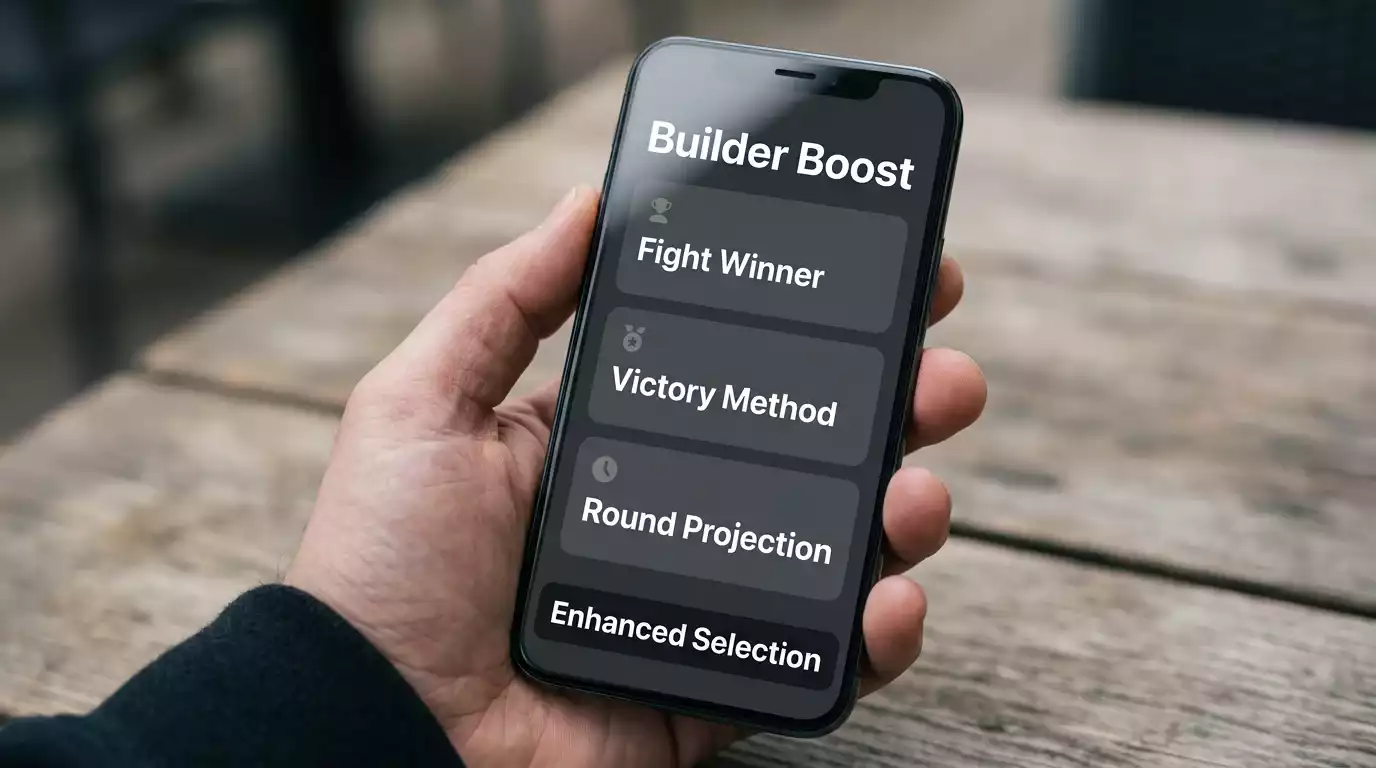
A 15% boost on a Winner + KO builder priced at 11/4 brings it to roughly 7/2. That is a genuine improvement in expected value if your base rate for the combination was accurate. The trap is assuming the boost makes the bet positive expected value when the un-boosted price was already too short. Check the un-boosted combination first — if it is fair value at 11/4, the boost to 7/2 is a real edge. If the un-boosted price was 4/1 fair and the operator was offering 11/4 with a “boost” to 7/2, the operator has dressed up a normal price as a promotion.
The cleanest discipline: ignore the boost label and price the combination from first principles. If the combination is positive expected value at the boosted price relative to your own probability estimate, take it. If it is not, skip it regardless of how attractively the boost is presented.
Value traps that mimic value
The most common bet builder mistake I see is “stacking for the price”. The bettor starts with a single-leg view they like, then adds two or three additional legs simply because the combined odds look attractive. The maths is straightforward and brutal: each additional leg multiplies more margin onto the slip, and the joint probability falls more than the apparent odds rise.
The second trap is “correlation-blind stacking”. The bettor adds Winner + KO + Under 2.5 + No Knockdown for Fighter B without realising that those legs are heavily positively correlated — if A wins by KO in round one, all three other legs land automatically. The combined price looks like 5/1 but the true joint probability is about 30%, meaning the operator’s correlation engine has built in a 30 to 40% margin on the slip.
The third trap is “the builder boost mirage” — picking a builder you would not have picked otherwise because the boost makes the headline number attractive. The bet builder should follow your read of the fight, not lead it. If your structural read on the fight is “A wins by decision after pace control”, the builder is Winner + Decision, full stop. Adding a knockdown leg because it is in the promo loses the structural integrity of the bet. Bet365’s MMA bet builder is the most-developed version on the UK market right now after the March 2026 partnership, and the structural design of the builder reflects what UFC same-fight pricing looks like when the operator has invested in the model.
How to actually use bet builders well
The best UFC bet builder strategy I have used over years: limit yourself to two-leg or three-leg same-fight builders, never more. Stake them at half your standard moneyline stake. Use the builder when you have a structural read that genuinely requires multiple legs to express — Winner + Method when both reads are conviction-grade, Winner + Round when the duration is part of the case. Skip the builder when your view is just “I think A wins” — moneyline is the cleaner expression. The fight’s complexity is what drives the builder; the builder is not a way to manufacture interest in a fight you do not have a read on.

The most useful builder habit is to compare the combined price to your back-of-envelope probability estimate of all the legs being true together. If the implied probability of the combined price is lower than your estimate, the bet has positive expected value. If it is higher, the operator’s correlation cut is eating your edge. Two minutes of mental maths per slip is enough to separate the builders that pay over time from the ones that drain your bankroll quietly.
Why won’t my UFC bet builder accept certain leg combinations?
The combination either creates a logical impossibility (events that cannot both be true, like KO finish + goes the distance) or it produces correlation the operator’s pricing engine cannot resolve. Mutually exclusive events get rejected outright; heavily correlated events often get rejected to prevent the bettor from constructing a near-certain combination at multiplied prices. The exact list of refused combinations varies by operator and is rarely published in full, so trial and error is sometimes the only way to know what your specific app will accept on a given UFC fight.
Is a UFC builder’s odds boost actually a boost or just a different price?
Some boosts are genuine — the underlying combination would have priced at a shorter number without the promotion, and the boost gives back a real percentage of the operator’s margin. Others are marketing reframing — the un-boosted price was already wider than the operator’s true model, and the boost brings it back to roughly fair value. The way to tell is to price the combination from first principles based on your own probability estimates. If the boosted price is shorter than the price you would consider fair, the boost is value. If it is longer, the operator has dressed up a normal price as a promotion.
Published by the bet on ufc Fight team.