Reading UFC Fractional Odds UK: Payout Calculations
 Available in US
Table of Contents
- Calculating Returns with UFC Fractional Odds UK
- What the fraction actually says
- The 5/2 worked example, three stakes deep
- The 11/10 and 6/4 lines that look almost like pickems
- Odds-on versus odds-against without the confusion
- Evens, Evs and the true pickem
- A quick fractional reference table
- How this habit pays off across a UFC card
Calculating Returns with UFC Fractional Odds UK
The first UFC bet I ever placed was a 5/2 on a Glasgow lightweight, and when the slip came back showing a £35 return on a tenner I genuinely thought the cashier had miscounted. Nine years and several thousand cards later, I still see UK bettors at fight-week meetups doing the same maths backwards — counting the return and trying to work out what the profit actually is. That confusion is exactly what this piece is built to fix.
What follows is a step-by-step walkthrough of UFC fractional odds for UK bettors, with the three line shapes you will meet most often on a British slip: the short price favourite, the near-pickem and the longer dog. I am not going to detour into decimals, conversion sheets or implied probability beyond the briefest mention. The plan is narrower and more useful: read the fraction, calculate the return, and stop second-guessing yourself when the cashier hands you the receipt. Almost every UFC slip you will see on a UK app defaults to fractional, so this is the form you need to read at a glance.
What the fraction actually says
I had a friend swear at me for an hour at UFC Manchester because he genuinely believed 5/2 meant he got £5 back from a £2 stake. He’d been at it for two years on a UK app without anyone correcting him. The fraction is profit-to-stake, not return-to-stake — and that single distinction is where most readers either get it or never quite trust it.
The number on the left is the profit. The number on the right is the stake you have to put up to win that profit. So 5/2 reads: stake £2, win £5 profit, get £7 back in total because they also hand you your stake. 11/10 reads: stake £10, win £11 profit, total return £21. The two numbers are not a ratio in the percentage sense, they are a payout instruction.
This becomes useful very quickly when you scan a UFC card. A fighter at 4/6 means you risk six to win four — clearly the favourite, because the stake is bigger than the profit. A fighter at 9/4 means you risk four to win nine — clearly the dog, because the profit dwarfs the stake. Once that rule is wired in, the whole card reads in two seconds. Roughly 53% of all UFC bouts end inside the distance, which matters here because shorter prices are often attached to expected finishers, and fractional pricing makes that easier to spot on the line itself.
The 5/2 worked example, three stakes deep
Take a typical UFC welterweight underdog at 5/2. That price flatters the maths because the numbers stay clean across realistic UK stakes.

On a £10 stake: profit is 10 × (5/2) = £25. Total return on a winning ticket: £25 profit + £10 stake = £35. On a £25 stake: profit is 25 × (5/2) = £62.50. Total return: £87.50. On a £50 stake: profit is 50 × (5/2) = £125. Total return: £175. Notice that for every £1 you put on at 5/2, you get £2.50 of profit back if it lands.
The mental shortcut I use is to multiply the stake by the top of the fraction, then divide by the bottom. That gives you the profit instantly. £25 × 5 = £125, divide by 2 = £62.50. The total return is always profit plus stake, so add the £25 back on and you land on £87.50. It is the same arithmetic you would have done in Year 7 maths, dressed up as a betting product. The reason people stumble is not the maths, it is the unfamiliarity of seeing a slash instead of a multiplier. Once you train your eye to read N/D as “profit per stake”, every UFC line on the card resolves in your head before the spinning loader finishes.
The 11/10 and 6/4 lines that look almost like pickems
Most UFC fights worth your time are not 5/2 dogs and 1/3 chalks. They sit in the middle, with one fighter at 11/10 and the other at 4/5 or 5/6. The shape of the line tells you how thin the bookmaker thinks the matchup actually is, and reading the maths quickly here is where you separate yourself from someone who just clicks the favourite.

At 11/10, a £10 stake returns £11 profit, total £21. At 6/4, a £20 stake returns £30 profit, total £50. The shortcut for 6/4 specifically: you can think of it as “1.5 times your stake back as profit”. That is faster than long-division in your head when an in-play window is closing on you.
Now the comparison. A 11/10 line implies the bookmaker sees that side as a marginal dog. A 6/4 line is a slightly bigger dog. The two prices feel similar, but on a £100 stake the gap is £110 versus £150 in profit — a £40 swing on a coin-flip fight. If you bet five of these a year and pick the wrong side of the price three times, you are leaking serious money to slippage. About 65 to 70% of UFC favourites win on a ten-year sample, which is exactly why these near-pickem prices need attention: it is in this band that the bookmaker’s margin and your read on the matchup actually meet.
Odds-on versus odds-against without the confusion
The most common mistake I see — and I mean weekly, in UFC betting forums — is reading 2/5 the way you would read 5/2. They are not the same fight from a different angle, they are opposite-direction prices.
5/2 is odds-against: the profit (5) is greater than the stake (2). The fighter is a dog. 2/5 is odds-on: the profit (2) is less than the stake (5). The fighter is a favourite. On a £10 stake, 5/2 wins £25 profit. On the same £10 stake, 2/5 wins £4 profit. Same digits, very different ticket.

The rule of thumb I drill into anyone I’m coaching: if the left number is smaller than the right, the price is odds-on and the fighter is short. If the left number is bigger than the right, the price is odds-against and the fighter is longer. UFC moneylines flip between the two constantly on a single card, so this is not a once-a-night problem. It happens five or six times across a Fight Night card and twice as often on a Numbered Event. Worth pausing for a beat to check direction before you commit. There is a deeper read on how to think about pricing across method markets in our breakdown of UFC bet types and their typical margins, which is where the fractional habit really starts paying off.
Evens, Evs and the true pickem
When you see “Evs” or “Evens” written next to a UFC fighter, that is the bookmaker’s shorthand for 1/1. A tenner returns a tenner profit, total £20 back on a winner. Mathematically, it is the cleanest line on the slip.
What you will more often see instead is 10/11 on both fighters, sometimes referred to as a “true pickem”. 10/11 means a £11 stake wins £10 profit — slightly worse than evens, with the gap absorbed by the bookmaker’s margin. Two 10/11 fighters in the same bout tell you the operator built in a small overround on both sides rather than offering true evens, which would carry no built-in margin.
For UK bettors, the practical reading is: if both sides are 10/11, the matchup is genuinely a coin flip in the operator’s model. If one side is Evs and the other is 5/6, the model is leaning a fraction one way. Neither of those lines is wrong, but the shape tells you something. I track these pickems specifically because they are where the bookmaker is least confident, and your edge — if you have one — has the most room to operate.
A quick fractional reference table
I keep this short card in the back of my phone notes for the first month of every season. Read it, memorise the rough percentages, and you will scan a UFC line in two seconds for the rest of your betting life.

1/4 = 20% implied — heavy favourite. 2/5 = 28.6% — clear favourite. 4/7 = 36.4%. 4/5 = 44.4%. 10/11 = 47.6% — near-pickem. Evs (1/1) = 50%. 11/10 = 52.4%. 6/4 = 60%. 2/1 = 66.7%. 5/2 = 71.4%. 4/1 = 80%. 8/1 = 88.9% — clear dog.
Two things to note. First, these are implied probabilities including the bookmaker’s overround, not “true” probabilities. Second, the table is symmetrical around 50% if you flip the fractions: 4/1 means a profit of four for every one staked, so the bookmaker is saying the event happens roughly 20% of the time. Memorise five anchor prices (Evs, 2/1, 4/1, 1/2, 1/4) and you can interpolate the rest by eye on a UFC card without ever opening a calculator.
How this habit pays off across a UFC card
Across a typical UK Fight Night with twelve bouts, you will see fractional prices ranging from roughly 1/4 to 5/1. If you read each line in two seconds, you cover the card in under thirty seconds and know exactly where the bookmaker has placed each fight on the chalk-to-dog spectrum. That is the foundation for everything else — odds shopping, builder construction, parlay leg selection — and it costs you nothing once the habit is wired in. The British slip will not let you skip this step, so make the read fast and accurate rather than slow and stressful.
How do I quickly tell a UFC favourite from an underdog when both lines look like small fractions?
Compare the left number to the right number. If the left is smaller, the price is odds-on and that fighter is the favourite — for example 2/5 or 4/9. If the left is bigger, the price is odds-against and that fighter is the underdog — for example 5/2 or 9/4. The closer both numbers are in size, the closer the fight is to a pickem.
Are UFC odds in betting shops shown differently from online UK fractional odds?
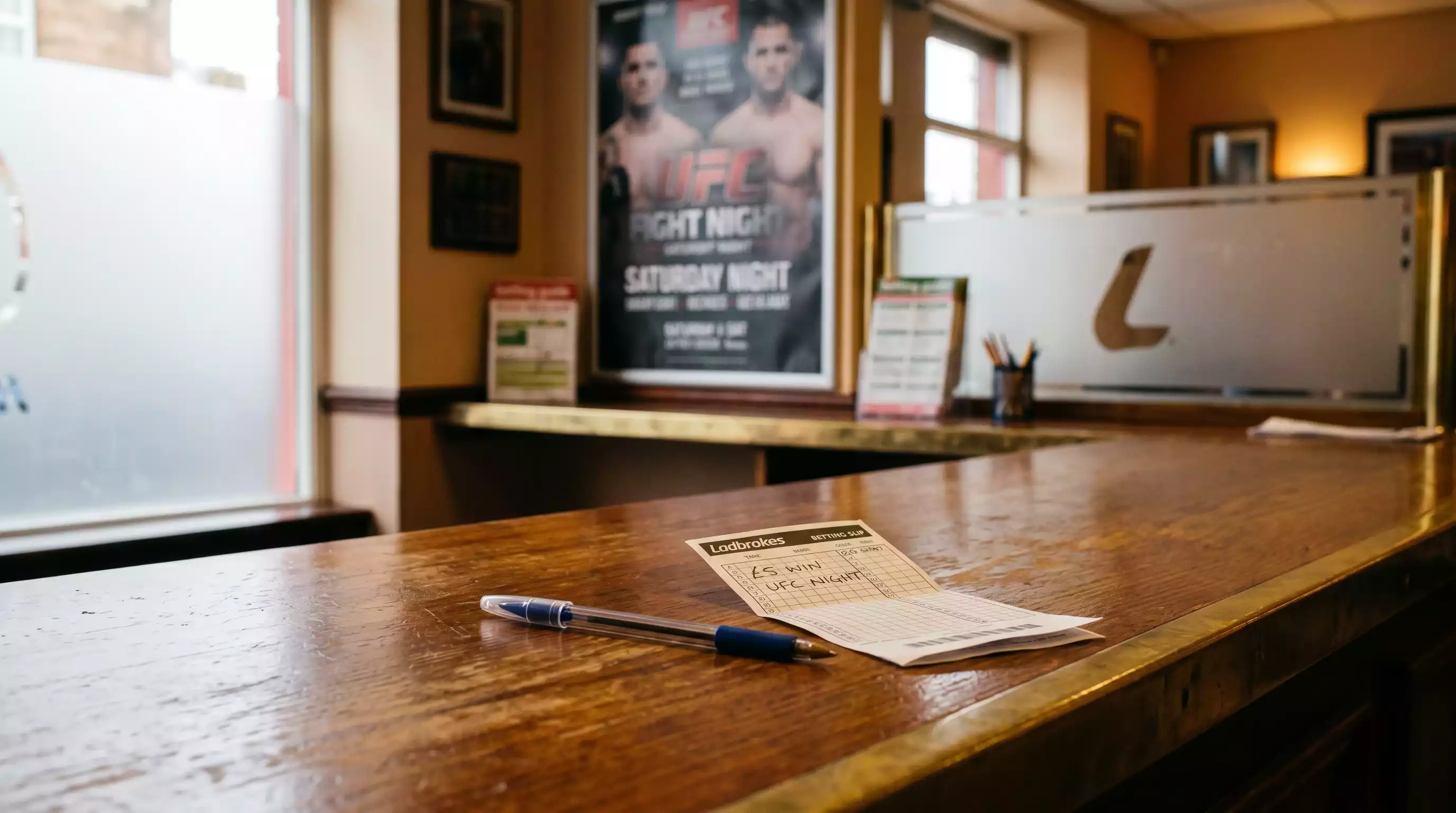
No, UK high-street shops use the same fractional format as online apps by default. A 5/2 on a Ladbrokes board on Kentish Town Road is the same price as 5/2 on the same operator’s app. The only practical difference is that shops sometimes round the next-out price slightly to keep boards readable, while online apps display the precise live price.
Written by the editors at bet on ufc Fight.